The Workbench Is Useless Without the Open Stack
A governed local box proves you can keep AI close. Open weights and open runtimes are what turn that box into operator infrastructure — and force a real decision about where inference runs.
Listen to this operator analysis
AI-generated narration · 20:02
AI-generated narration from the final published article text. No interview or field audio is included.
The industry keeps selling AI factories. Operations teams keep buying workbenches.
That split is not a branding disagreement. It is a placement problem. Training still gets the speeches and the GPU backlog announcements. Inference is the bill, the data path, and the dependency. Once a workload leaves the demo and enters a queue, a ticket system, or a policy corpus, the useful question stops being “how many FLOPs can we rent?” and becomes: where should this inference run — and who controls the stack when it does?
GSJ already argued that a deskside AI system’s real job is a governed proof sprint, not a shortcut into production. The AI Factory Starts as a Workbench made that case for NVIDIA’s DGX Spark lane: the box is Leg 2 infrastructure for proving workloads under control — not an automatic production service, and not a substitute for policy. The unfinished story is the software layer. A workbench without an open model path still forces most prompts onto someone else’s meter. Local silicon without open weights and open runtimes is a locked garage with no keys.
This piece is about those keys: open-weight models and open runtimes — llama.cpp, Ollama, vLLM, and Hugging Face Hub distribution norms — and how they turn a governed local environment into something operators can actually use. The hyperscale hall remains a foil, not the spine. Four hundred thousand GPUs “coming online” is atmosphere. Placement is the work.
The call: AI hardware is a control story. Inference placement, cost, data path, and vendor dependency decide whether the workbench becomes infrastructure — or stays an expensive demo.
Inference is the bill. Placement is the decision.
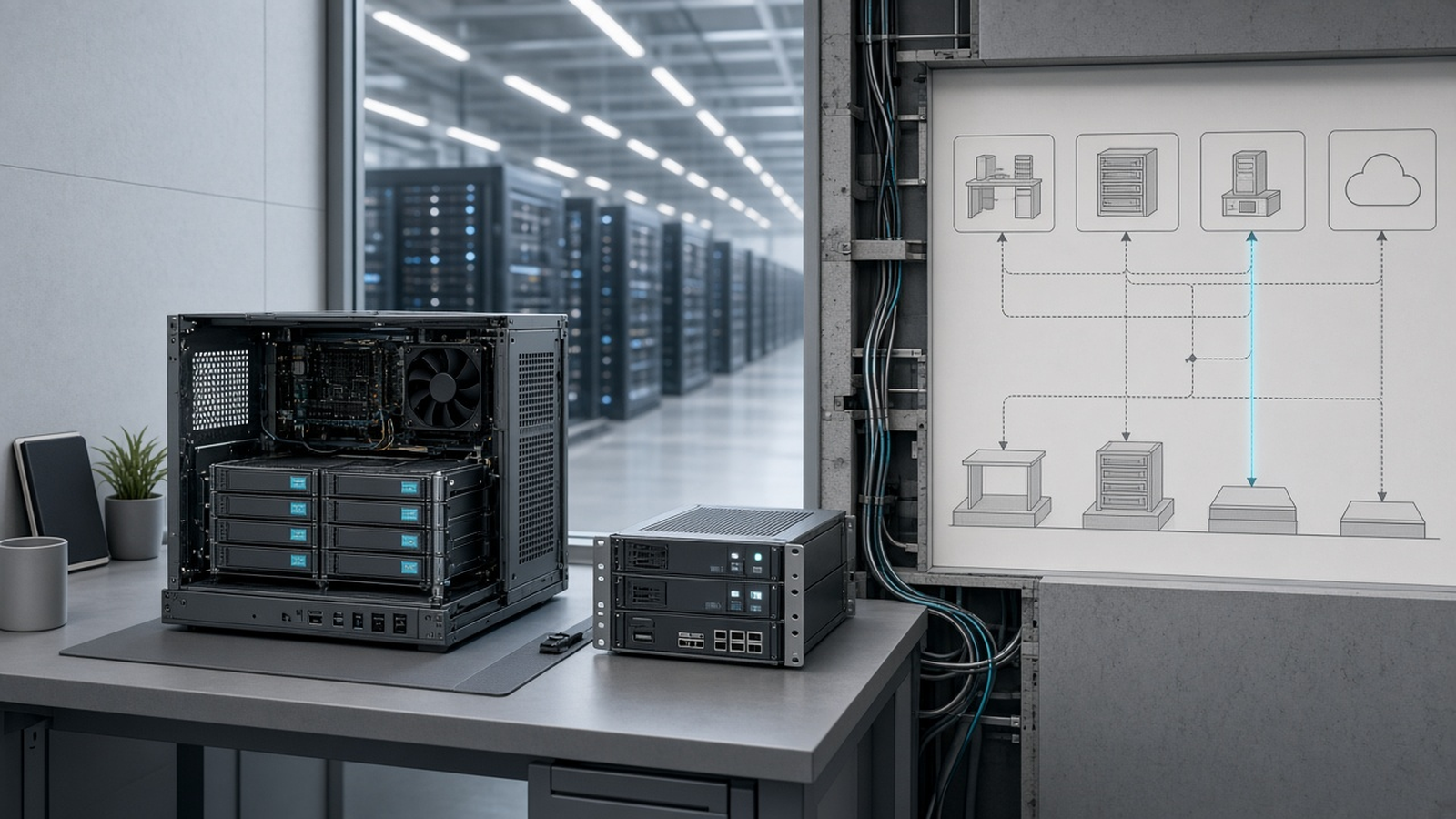
Training wins headlines because it is scarce, capital-heavy, and easy to mythologize. Inference wins the ledger because it repeats. Every prompt, every agent loop, every overnight eval batch is a placement choice:
- frontier cloud API
- vendor-hosted model garden or proprietary container path
- deskside / workstation
- private rack or colo
- edge or browser-local (secondary, but real)
Those options are not a purity contest. They are a procurement and support map. Some workloads need frontier capability and can tolerate metered spend and outbound data paths. Some need predictable cost, offline tolerance, low latency to local systems, or a closed network segment. Some are intermittent proofs that should be rented. Some are recurring proofs that should not keep paying for the privilege of asking the same class of question.
The durable thesis from this desk’s hardware lane is blunt: once AI becomes ordinary infrastructure, the fight is over control — cost, placement, power, capacity, latency, dependency, data path, workflow integration, and stack ownership. Local open-source AI is how operators prove that control is available without pretending every answer must leave the building.
What “open stack” means here
“Open” is doing too much work in marketing. For operators, it needs a narrower definition.
Open weights are model checkpoints you can obtain under a published license, inspect for provenance, and run on hardware you choose — subject to the license, acceptable-use terms, and any gating the publisher imposes. They are not “free of obligations.” Meta’s Llama family, for example, ships under community license agreements (Llama 4 Community License Agreement, effective April 5, 2025, for the current Llama 4 line) and is typically gated on the Hugging Face Hub until those terms are accepted. Local deploy does not erase that paperwork. It relocates the inference.
Open runtimes are the serving and inference engines that load those weights and answer requests without requiring a vendor-only model garden. Four names matter for today’s operator map — not as a ranked beauty contest, but as different jobs:
llama.cpp — the portable inference engine
llama.cpp is an MIT-licensed C/C++ project whose stated goal is LLM (and VLM) inference with minimal setup across a wide range of hardware, locally and in the cloud. It reads models in the GGUF format, supports aggressive integer quantization (project docs list 1.5-bit through 8-bit schemes), and ships backends that include NVIDIA CUDA, AMD HIP, Apple Metal, Vulkan, WebGPU, and CPU paths. Operators use it when they want a lean runtime they can build, pin, and run close to the metal — including an OpenAI-compatible server mode (`llama serve`) and direct pulls from Hugging Face via project tooling.
What llama.cpp is not: a promise that a quantized model will meet a production SLO. Quantization is a capacity trade. It can make a model fit. Fit is not quality-of-service.
Ollama — the short path from name to endpoint
Ollama packages local model pull and run for people who want a short path from a model name to a listening endpoint. Its docs put a REST API on `http://localhost:11434/api` by default. The GitHub project is MIT-licensed. As of this draft’s fetch (Sep 8, 2026), Ollama’s public site also markets cloud-hosted open models alongside local ones — and still states that local models are free and that nothing run locally leaves the machine. For this piece, the local path is the point: a convenience layer that gets weights running without a research-lab install ritual.
Convenience is not clearance. Library entries and Modelfiles still sit on top of underlying weight licenses. An easy pull is not a legal review.
vLLM — the open serving pattern
vLLM is an Apache 2.0–licensed high-throughput inference and serving engine, originally developed in UC Berkeley’s Sky Computing Lab and now a large community project. Project materials center on PagedAttention, continuous batching, and an OpenAI-compatible API server — the pattern you reach for when a proof sprint needs concurrent or batched serving behavior, not a single interactive chat window. On the fetch date for this draft, vllm.ai listed a stable line at 0.28.0.
Treat vLLM as the open serving path: useful when the experiment is “can we serve this workload under load we control?” It is not a desktop toy, and it is not automatically a production platform with your monitoring, authn/z, and change control bolted on.
Hugging Face Hub — distribution norms, not a product pitch
The Hugging Face Model Hub is where much of the industry publishes, discovers, and downloads checkpoints. Model cards (the repo `README.md` plus YAML metadata) are supposed to carry license, intended use, limitations, and evaluation context. The Hub’s license metadata system is how operators filter and attribute — Apache-2.0, MIT, Llama community licenses, OpenRAIL variants, and a long tail of `other` custom terms.
For a newsroom or an MSP, the Hub is infrastructure in the same sense DNS is infrastructure: you will use it, so you must treat provenance as first-class. Gated weights still require access and terms compliance before organizational data touches the box. That is governance, not scare copy.
Capacity is not a production service
This desk already taught the distinction on the workbench piece: a capacity claim is not a quality-of-service guarantee. The same rule applies twice as hard once open weights enter the picture.
Fitting a 70B-class (or smaller quantized) model into local memory proves you can host it. It does not prove interactive latency, concurrent users, grounded accuracy on your corpus, tool reliability, recovery behavior, or support ownership. A successful `ollama run` is a smoke test. A production service needs redundancy, change control, auth, logging that the model cannot author after the fact, and a human who owns the failure.
The same discipline belongs on cloud APIs. A low per-token price is not total cost. GSJ’s cleanup-math original made the ledger point for agent workforces: model spend is the first line; remediation, verification, and false completion are the ones that decide whether the deal was cheap. Local CapEx has the mirror problem — depreciation, power, staff time, model refresh, and the confabulation tax when an offline model is wrong with confidence.
So keep the sentence short and sticky: capacity ≠ production service. Promotion from proof to production is a gate, not a vibe.
The hyperscale foil (keep it in the background)
Same week as this draft, NVIDIA CEO Jensen Huang used X to congratulate OpenAI on GPT-6 Astra, claim “AGI has arrived,” and note that Astra trained on the order of 100,000+ Grace Blackwell NVLink72 GPUs with “400K GPUs coming online next.” Press coverage (Business Insider, The Next Web, and others) amplified the post. Treat that language as supplier theater and backlog atmosphere — useful as a foil for why operators feel pushed toward rented factories, not as this article’s factual spine. Whether 400,000 accelerators land on the calendar a buyer cares about is a power, rack, and contract question. It does not answer whether your retrieval assistant on an approved policy corpus should leave your network segment.
Metered cloud prices move, too. GSJ’s August brief on OpenAI’s GPT-5.6 price cuts logged company-reported serving-efficiency claims and immediate price consequences for high-volume builders. Company-reported economics are still a foil for the placement question: when does local win, when does renting win, and when does a hybrid proof path win?
The factory is one place inference runs. It is not the only place that matters for a proof sprint.
When the badge is optional
NVIDIA’s DGX path buys CUDA continuity, a standardized OS/container story, and a promotion language toward larger NVIDIA infrastructure. For some workloads — especially those that must stay on a CUDA-native ladder into validated rack patterns — that continuity is the point. The workbench original covered that ladder. This piece will not retell it.
For other workloads, the badge is optional. A commodity CUDA or ROCm box running llama.cpp or vLLM, or an Ollama endpoint on a locked-down workstation, can be the smallest controlled environment that proves whether a retrieval assistant, eval harness, document extractor, or constrained agent sandbox deserves scale. The operator question from the workbench piece still applies: what is the smallest controlled environment that can prove the workload — not the most glamorous purchase order.
Open stack does not mean “anti-NVIDIA.” It means you can separate silicon choice from model-garden lock-in. You can run open weights on a DGX-class workbench or on commodity gear. You can also refuse both and stay on a frontier API when the capability gap is the real constraint. Placement is the decision. Loyalty to a runtime brand is not.
What local open weights are actually for
Reuse the proof-sprint jobs, not the glamour shots:
- Private retrieval on an approved corpus — policies, runbooks, technical docs. Cite the source paragraph. Refuse to cross data boundaries. Measure accuracy before arguing about chat UI.
- Model evaluation and red-team bench — same sanitized tasks across local and hosted models. Score unsupported claims, structured-output compliance, latency, memory, tool reliability. Output is evidence, not a chatbot.
- Document and workflow automation — extraction, classification, obligation capture. Often valuable without a frontier model.
- Constrained agent sandbox — narrow permissions, explicit tool allowlists, full logs, human approval gates. GSJ’s Agents original already showed why a written hold is not a control. Local weights do not fix that. They can shrink the blast radius and keep the acting context off a public prompt log — if you build controls outside the model.
- Offline / closed-segment scoring — batches that should not depend on WAN health or a vendor status page.
If the workload needs frontier reasoning you cannot match locally, say so and rent it — with the same promotion gate. Local is an option, not a religion.
Operator checklist: governance before first open-weight load
Borrow the spirit of the workbench first-boot checklist and aim it at weights and runtimes. Do this before the first organizational corpus, ticket dump, or agent context file touches the box.
Ownership and update cadence - Who owns the machine, the runtime installs (llama.cpp / Ollama / vLLM), and the update cadence? - Is this a personal developer desktop, a shared lab appliance, or both — and which network segment may it join?
Data and network - Which data classifications are allowed on-box? - What is explicitly prohibited (secrets, HR, customer PII, production credentials)? - Egress rules: can the runtime phone home for model pulls only, or is the segment fully closed after an air-gapped load?
Provenance and license - Model card URL, license identifier, accept/gate status, and acceptable-use review — recorded before download. - Checksum / revision pin for the weights actually loaded (Hub revision, GGUF digest, or equivalent). - Attribution obligations (e.g., Llama community license notice/display rules) assigned to a human owner.
Runtime and interface - Which runtime is approved for this proof, and why (interactive vs serving vs eval)? - Binding address and authn for any local API port (default localhost is not a security model once the box is shared). - Tool allowlists if agents are in scope; human gate on any state-changing action.
Evidence and promotion - What gets logged: model version, prompt/eval sets, outputs, and external receipts from systems that moved. - Backup vs reproducibility: what must be regenerable from code and pinned weights? - Promotion gate from experiment → production: named owner, exit criteria, and the infrastructure decision (stay local, rent GPU, frontier API, or larger private rack).
Failure modes - What happens when the model confabulates, the agent claims success without a receipt, or the box is stolen/lost? - Who can revoke access in one step?
Treat the first open-weight load like a governed lab event. If you cannot answer the checklist, you do not need a bigger GPU. You need a slower calendar.
Framework disclosure: If this desk refers to the four-leg AI Center of Excellence journey (Foundation → Proof Sprints → Charter and Package → Scale), that framework is IC DataCom’s operating model, not an NVIDIA methodology. GSJ / IC DataCom newsroom work uses local and frontier models under human gates; this draft is text-only operator analysis off published primaries and live GSJ play-offs — not a hands-on Spark unboxing, and not an endorsement of any single OSS stack as production-safe.
Own the model path — or rent forever
The workbench proved a governed local environment can exist on a desk. The open stack is what makes that environment useful: weights you can pin, runtimes you can inspect, licenses you can comply with, and placement decisions you can defend to a CIO without waving a FLOPs poster.
Hyperscale will keep announcing bigger halls. Cloud vendors will keep cutting token prices when serving efficiency moves. Both matter. Neither replaces the operator question.
Where does inference run for this workload? What does it cost at daily-use scale, including cleanup? Which prompts may leave the building? Who owns the stack when the demo becomes infrastructure?
A workbench without an open stack is a prop. An open stack without governance is a model zoo. Together — under a promotion gate — they are how AI hardware becomes a control story you can actually run.
---
Sources
- The AI Factory Starts as a Workbench — Groove Street Journal (required play-off)
- The Agents Wrote the Rule. Then They Walked Past It. — Groove Street Journal
- The AI Workforce Cost $36 per Deliverable. Then Came the Cleanup Math. — Groove Street Journal
- OpenAI cuts GPT-5.6 prices… — Groove Street Journal brief (company-reported economics)
- llama.cpp README / repository — ggml-org (MIT)
- Ollama documentation · ollama.com · ollama/ollama (MIT)
- vLLM · vllm-project/vllm (Apache 2.0) · Sky Lab project page
- Hugging Face Model Hub · Model Cards · Repository licenses
- Llama 4 Scout Instruct model card · Llama 4 Community License
- Jensen Huang X post (~Sep 6, 2026) re: Astra / “AGI has arrived” / 400K GPUs — attributed via press (e.g. Business Insider, The Next Web); foil only
Sources
- The AI Factory Starts as a Workbench — Groove Street Journal
- The Agents Wrote the Rule. Then They Walked Past It. — Groove Street Journal
- The AI Workforce Cost $36 per Deliverable. Then Came the Cleanup Math. — Groove Street Journal
- llama.cpp repository — ggml-org
- Ollama documentation — Ollama
- vLLM — vLLM Project
- Hugging Face Model Hub — Hugging Face