The Safety Lab That Became Infrastructure
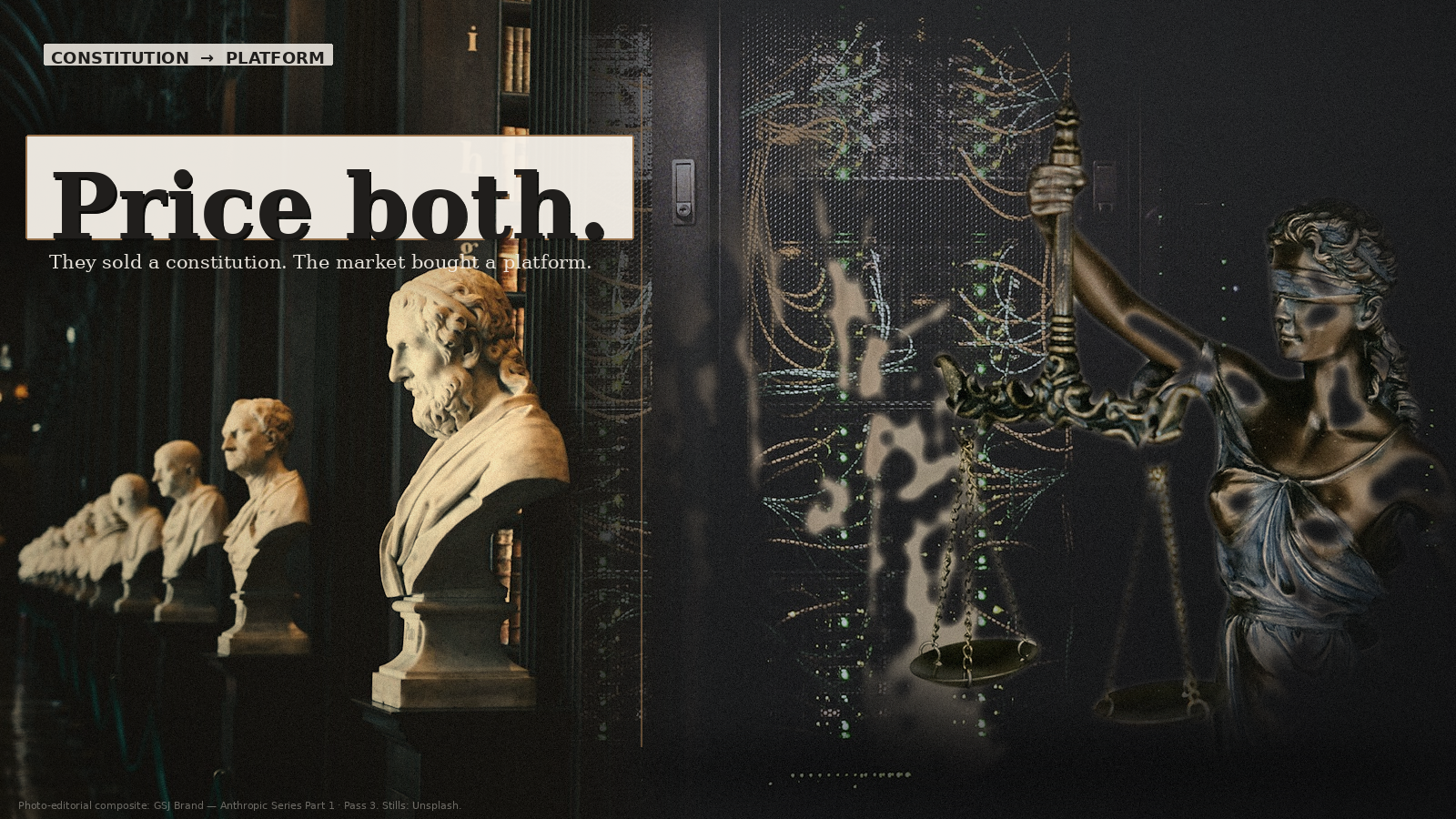
Anthropic sold the world a constitution. The market bought a platform. The IPO will force the world to price both.
Listen to this article
AI-generated narration · 22:36
AI-generated narration from the final published article text. No interview or field audio is included.
In less than five years, Anthropic went from a safety-first research lab with a constitutional brand to one of the most heavily financed private companies on Earth. On May 28, 2026, Anthropic announced it had closed a Series H that raised $65 billion at a $965 billion post-money valuation—led by Altimeter Capital, Dragoneer, Greenoaks, and Sequoia Capital, with a long co-lead and co-investor list that now reads like a map of global capital itself. In the same announcement, the company said its run-rate revenue had crossed $47 billion earlier that month.
That is not a consumer-app story. It is an infrastructure story wearing a research lab’s clothes.
The founding pitch was deliberate. Anthropic spun out of OpenAI alumni who wanted a different alignment culture, branded the work around Constitutional AI, and wrapped the company in public-benefit / mission rhetoric that made "careful" feel like the product. That brand still opens doors. It is no longer what closes the purchase order. Enterprises bought Claude as a production system—coding agents, workflow tools, API capacity, and multi-cloud availability wired into real operations. The IPO scaffolding now being reported around the company will require investors to price both stories at once: the constitution and the platform.
This piece is Part 1 of a Groove Street Journal series on Anthropic. It covers the business—capital, revenue claims, compute, competition, and the pre-IPO machine. Later parts will take the product, safety posture, and public-market narrative on their own terms. GSJ and related ICDC operations use frontier models in daily work, including Claude-class tools; that is disclosed here as operator transparency, not as an endorsement of any funding round, valuation, or IPO timetable.
From Series G to Series H: the capital ladder
The runway into Series H was already extreme. On February 12, 2026, Anthropic announced a Series G of $30 billion at a $380 billion post-money valuation, led by GIC and Coatue and co-led by D. E. Shaw Ventures, Dragoneer, Founders Fund, ICONIQ, and MGX. The company said the round would fund frontier research, product development, and infrastructure expansion—and it claimed market leadership in enterprise AI and coding. CNBC, covering the same day, framed the raise as the second-biggest private financing round on record for tech after a prior OpenAI mega-round: a reminder that Anthropic's capital story is inseparable from a sector-wide arms race.
In that February post, Anthropic put hard numbers on the commercial machine then in motion. Company claim: run-rate revenue was $14 billion, growing "over 10x annually in each of those past three years." Customers spending more than $100,000 annually on Claude (by run-rate) had grown 7x in a year, the company said. The count of customers spending over $1 million annually on an annualized basis had gone from a dozen two years earlier to more than 500. Eight of the Fortune 10 were Claude customers, per the company. Those are concentration and expansion metrics dressed as growth metrics: not only more buyers, but buyers deepening spend.
Claude Code was the clearest proof point. Made available to the general public in May 2025, the tool's run-rate revenue had grown to more than $2.5 billion by the Series G announcement—more than double since the start of 2026—while weekly active users had also doubled since January 1, Anthropic said. Business subscriptions had quadrupled since the start of 2026, and enterprise use represented over half of Claude Code revenue, again per the company. CEO Dario Amodei told CNBC around that period that about 80% of Anthropic's business came from enterprises. That mix matters for valuation logic. Consumer chat can spike on cultural weather. Enterprise seat expansion, API attach, and coding agents embedded in repositories compound differently—and break differently when a CIO cuts budget.
Three and a half months later, Series H reset the scale again. The May 28 company announcement put the raise at $65 billion and the post-money at $965 billion. Co-leads included Capital Group, Coatue, D1 Capital Partners, GIC, ICONIQ, and XN. The investor roster spanned sovereign wealth, public-market giants, private equity, and strategic chip and memory suppliers—Micron, Samsung, and SK hynix among them. The round also included $15 billion of previously committed hyperscaler investments, including $5 billion from Amazon. TechCrunch noted that a portion of the demand had been visible in the weeks before close—investors clamoring for allocation at a moment when private AI marks were already straining ordinary venture math.
CFO Krishna Rao framed the raise as demand capture, not merely model R&D: funding to serve “historic demand,” stay at the research frontier, and bring Claude to “more of the places where work happens.” Brad Gerstner of Altimeter cast Anthropic as positioned for “the next phase of AI innovation.” Sequoia’s Alfred Lin put the commercial claim more bluntly: startups and Global 5000 companies alike were deploying Claude into complex workflows—and learning “the context, the processes, the judgment.” Greenoaks’ Neil Mehta leaned into culture and mission as commercial momentum; Dragoneer’s Marc Stad called the progress “breathtaking” and still early. Investor quotes are ritual. They also telegraph what buyers think they purchased: not a chatbot, an operating layer.
The arithmetic between February and May is the story investors will argue about. A private company that disclosed a $14 billion run-rate (company claim) in mid-February claimed a $47 billion run-rate (company claim) by late May. That is company language, not audited public filings. It is also the kind of trajectory that makes a near-trillion private mark feel, to some buyers, like an interim stop rather than a destination. Public markets will eventually demand a sharper definition of "run-rate," cohort durability, and how much of the print is seat expansion versus price, usage, or one-time projects. Until then, the ladder itself is the signal: Series G at $380 billion post-money; Series H at $965 billion; and a press environment already auditioning larger numbers for the listing.
What the market actually bought
Anthropic's brand still leads with safety and constitution-style alignment. The purchase order, increasingly, does not.
Enterprises do not wire a model into core operations because the lab published a good essay. They buy because the model clears a threshold on coding, analysis, document work, and agentic workflows; because it is available where their cloud estate already lives; and because switching costs rise once the tool is inside repositories, tickets, and approval chains. Anthropic's own Series G language made that explicit: customers starting with a single use case—API, Claude Code, or Claude for Work—were expanding integrations across their organizations. That land-and-expand pattern is classic enterprise software behavior applied to frontier models. It is also how a safety brand becomes a default vendor without ever staging a consumer Super Bowl ad.
That is platform behavior. Platform companies win when they become default infrastructure for a category of work. Claude Code's claimed share of GitHub public commits—Anthropic cited a recent analysis estimating 4% worldwide, double the share from a month earlier—matters less as a precise market statistic than as a signal of habit formation. The figure is company-cited, not independently audited here; treat it as directional color. Once a coding agent is in the loop, the lab behind it is no longer only a chatbot vendor. It is part of the software supply chain. Procurement notices. Security teams notice. So do competitors who suddenly find their own coding tools measured against a new default.
OpenAI remains the consumer face of generative AI. Anthropic has leaned the other way: enterprise-heavy revenue, developer tools that go viral inside companies, and a multi-cloud distribution strategy designed for procurement reality. That split is not morality. It is product-market fit with different buyers. Consumer gravity wins attention and cultural lock-in. Platform gravity wins budgets that renew. An IPO will force a synthesis: can Anthropic keep the enterprise attach that justified private marks while still explaining itself to a public audience that mostly knows AI through ChatGPT?
There is a second product thread in the company's own February language that foreshadows the platform thesis. Anthropic pointed to Cowork and a broader push beyond pure coding—financial and data analysis, sales, cybersecurity, scientific discovery—plus healthcare and life sciences availability under HIPAA for Claude for Enterprise. Whether those categories become revenue pillars or slideware is a Part 2 product question. For the business story, the signal is intent: Anthropic is selling work systems, not only chat sessions.
Compute as the balance-sheet product
No frontier lab is only software. The Series H post made the power and partnership map unusually concrete.
Anthropic said it had signed agreements with Amazon for up to five gigawatts of new capacity; with Google and Broadcom for five gigawatts of next-generation TPU capacity; and with SpaceX for access to GPU capacity in Colossus 1 and Colossus 2. Claude, the company said, was the first frontier model available on all three of the world's largest cloud platforms—Amazon Web Services, Google Cloud, and Microsoft Azure—with AWS remaining its primary cloud provider and training partner. Earlier, in the Series G post, Anthropic had already emphasized diversified training and serving hardware—AWS Trainium, Google TPUs, and NVIDIA GPUs—as a resilience pitch to enterprises that fear single-vendor choke points.
Those are not decorative partnerships. They are the industrial base under the revenue claim. Five gigawatts is utility-scale language. Memory and storage suppliers joining the round as strategic investors underline the same point: the bottleneck is not only model weights. It is wafers, racks, power, networking, and the multi-year contracts that secure them. When a lab's financing announcement reads like a grid interconnection filing, the market is no longer valuing a research boutique. It is underwriting a capacity business with a research culture attached.
For public-market investors, this is where the constitution story and the platform story collide. Safety research and interpretability are listed uses of the Series H capital. So are expanding compute and scaling products. A public company will have to show how those priorities compete when quarterly numbers arrive—and whether "safety lab" remains a governing identity or becomes a brand layer on top of a capacity business. Diversified silicon helps the resilience narrative. It does not erase the fact that frontier training remains one of the most capital-intensive product strategies in technology. The IPO will not only price Claude. It will price the cost of keeping Claude at the frontier.
The IPO machine, carefully attributed
Anthropic has not, in the primary sources reviewed for this installment, publicly confirmed an IPO valuation, deal size, or final launch date. What exists in early September 2026 is reporting—sourced to people familiar with the matter—about timing, financing scaffolding, and investor talk. That distinction is not pedantry. It is the difference between a priced security and a rumor with good sourcing.
According to Reuters reporting circulated in early September, Anthropic was expected to begin marketing an IPO in mid-October at the earliest, with the prospectus pushed toward late September rather than an earlier window, and plans subject to change. The same reporting described a possible listing days before the U.S. midterm elections in November, again with the usual caveat that schedules move. Reuters-linked coverage also noted that some investors have discussed a figure around $2 trillion. That figure is attributed investor talk—not an Anthropic fact, not a company target disclosed in materials reviewed for this piece, and this series will not treat it as one. Secondary coverage of investor modeling has likewise stressed that company executives have not publicly set a $2 trillion target; the number travels in the press because the private marks already invited extrapolation.
Bloomberg reported separately that Anthropic was nearing finalization of an expanded revolving credit facility of about $15 billion ahead of a public filing, with Morgan Stanley leading the process and Goldman Sachs, JPMorgan, and Citigroup also in prominent roles—banks that reporting has also tied to the IPO syndicate. Credit facilities of that size are not decoration. They are liquidity architecture for a company whose cost structure is dominated by compute and whose growth story depends on never being short of either chips or cash. Reuters-linked accounts described the facility as a step before analyst meetings and prospectus publication, with a potentially tighter-than-usual gap because bank analysts already know the company well.
TechCrunch, covering Series H on May 28, framed the round as potentially the last major private raise before public markets—and noted OpenAI's parallel fundraising race. The competitive backdrop matters: OpenAI owns consumer mindshare; Anthropic owns a growing share of enterprise workflow; Microsoft sits in both ecosystems as investor, distributor, and now rival model builder. A listing timed into that rivalry is not only a financing event. It is a referendum on which AI business model public markets prefer to underwrite at scale.
None of this is a prospectus. Until an S-1 is public and the roadshow begins in earnest, every timetable and every trillion-dollar whisper should be read as provisional reporting, not company guidance. The honest question for the public filing is narrower: when the filing lands, which of the company-stated run-rate claims survive the lawyers' footnotes—and which investor fantasies quietly disappear from the marketing deck.
Competitors: consumer gravity vs. platform gravity
The competitive map is not a two-horse race with a clean winner.
OpenAI still defines the consumer category. ChatGPT trained the world to expect a conversational interface; that cultural default is durable. Anthropic's counter is not a better meme. It is denser enterprise attachment—especially through coding and work products that sit closer to revenue-producing labor. CNBC's Series G coverage captured the contrast cleanly: Anthropic early success selling to enterprises while OpenAI largely rode consumer popularity. Both companies are now racing toward public markets with different scar tissue and different dependency graphs.
Microsoft complicates both stories. It has invested in Anthropic and distributes Claude on Azure, while also building its own MAI model family to cut third-party model spend. At Build 2026, Microsoft unveiled in-house models positioned for efficiency and coding; Microsoft AI chief Mustafa Suleyman told Bloomberg that Anthropic was "extremely expensive" and that Microsoft's goal was to "reduce and ultimately eliminate" what it pays Anthropic. Subsequent reporting, including from the Seattle Times, described Microsoft routing some Excel and Outlook workloads to MAI models as a cost-reduction path, while still depending on external frontier models for much of its broader AI surface. CNBC's Build coverage likewise framed MAI as an attempt to lessen reliance on OpenAI and Anthropic and to capture more of the stack economics inside Azure.
That is the enterprise buyer's real environment: multi-model, multi-cloud, cost-aware, and increasingly unwilling to treat any single lab as permanent infrastructure. Anthropic's "first on all three clouds" claim is a hedge against exactly that buyer psychology. Microsoft's MAI push is a reminder that the hedge has a half-life. Distribution partners who also build competing models are not villains in a cartoon. They are rational actors optimizing COGS. Any Anthropic IPO narrative that assumes eternal Azure pull-through without pricing pressure is writing fiction.
Google remains the vertically integrated threat—models, cloud, TPUs, and distribution through its own products. Amazon remains Anthropic's primary training and cloud partner and a major capital participant. The web of dependency is the point. No one in this market is only a customer or only a competitor. That entanglement is bullish for Anthropic's near-term distribution and awkward for anyone who wants a clean story about independence. Public filings will have to describe concentration risk with more precision than a launch blog post.
What the IPO has to price
Strip the mythology and the business question is blunt.
Can Anthropic convert enterprise habit into durable, disclosed economics under public-market scrutiny? Can it fund gigawatt-scale compute without the capital structure becoming the product? Can a company that marketed itself as the careful alternative keep that identity while competing on coding agents, workflow automation, and cloud ubiquity? And can investors separate company-stated run-rate claims from the audited reality that only arrives with filings?
Series H answered a private-market question: enough buyers believed the trajectory to clear $65 billion at a $965 billion post-money mark. Public markets ask different questions. They price dilution, concentration risk, customer retention, compute commitments, partner conflicts, and the credibility of safety claims when those claims meet quarterly incentives. They also price narrative risk: the gap between the constitution Anthropic sold and the platform the market bought.
There is no requirement that those two identities cancel each other. Plenty of durable companies carry a founding ethic and a hard commercial machine at the same time. The requirement is honesty about which one is doing the revenue work. If Claude's enterprise attach is real, the safety brand is a differentiator and a risk-management story, not a substitute for unit economics. If the attach weakens under multi-model procurement and in-house hyperscaler models, no amount of constitutional poetry will hold a trillion-class mark.
Anthropic sold the world a constitution. The market bought a platform. The IPO will force the world to price both—whether or not either side likes the number that comes back.
---
Sources
- Anthropic Series H announcement — Anthropic
- Anthropic Series G announcement — Anthropic
- CNBC Series G coverage — CNBC
- TechCrunch Series H / pre-IPO — TechCrunch
- Bloomberg pre-IPO credit facility — Bloomberg