After AI Gets Boring, Quantum Has to Get Useful
The machines are getting larger, stranger and less wrong. That does not mean they are useful yet. A field guide to quantum computing's hardware race, error-correction problem, and possible place in the world after artificial intelligence becomes ordinary infrastructure.
Listen to this feature
AI-generated narration · 35:26
AI-generated narration from the published article text. No interview or field audio is included.
On August 19, IBM announced that it had connected two refrigerator modules and cooled them inside a shared environment.[1] That sentence sounds less like a computing milestone than the setup for an appliance-store stunt. The photographs tell a different story.
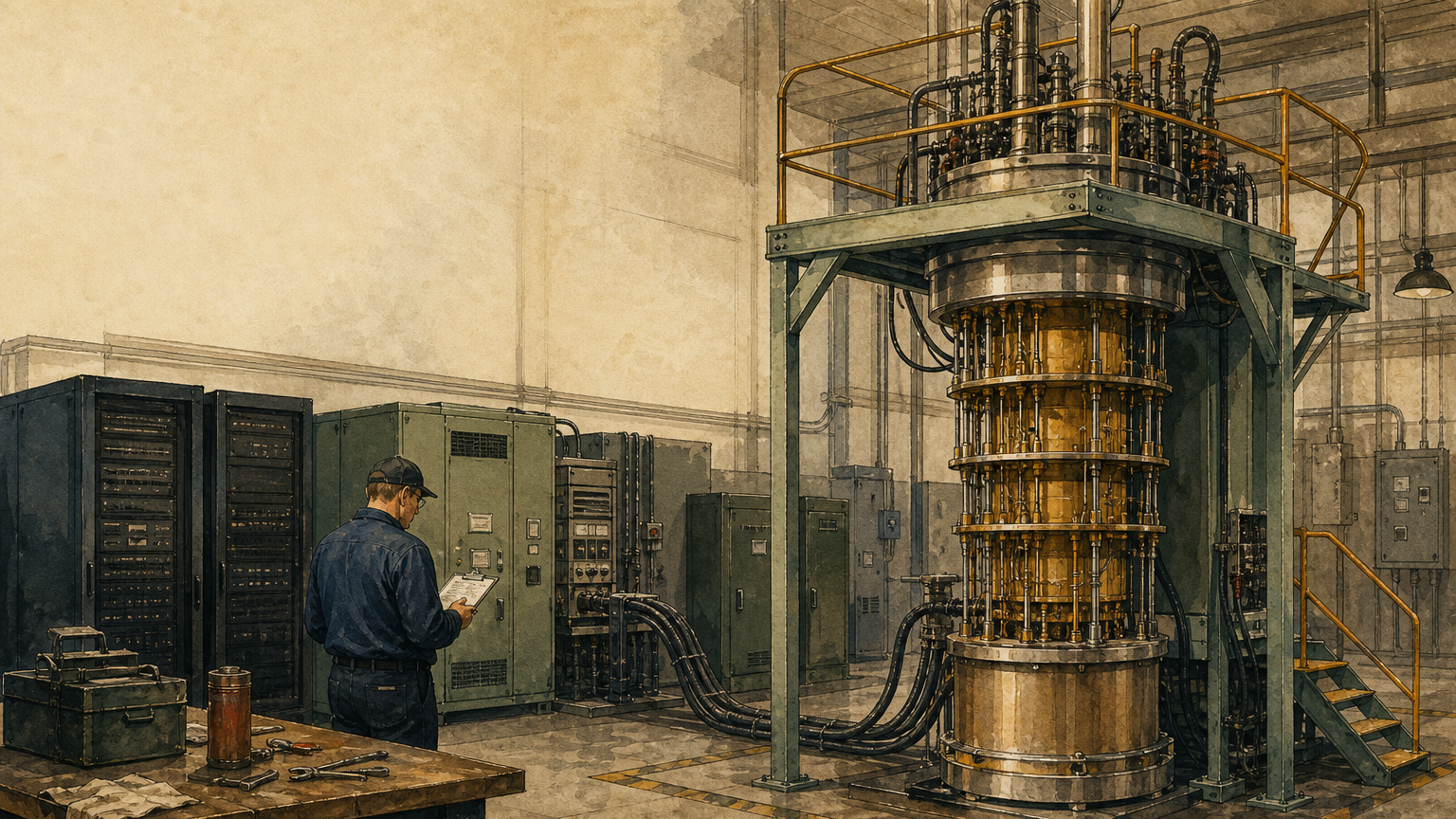
Each module is taller than a person. Pipes crowd the roof. Shields, plates, vacuum chambers and wiring descend toward the place where a quantum processor will eventually sit at a temperature below 15 millikelvin. That is colder than deep space by a factor of more than 180, according to IBM. The company says the paired system is a step toward linking hundreds of chips and, eventually, delivering a fault-tolerant machine called Starling in 2029.[1][2]
A classical data center announces itself through scale: acres of racks, megawatts of power, fans shoving hot air down an aisle. A quantum computer announces itself through control. It is a machine built to prevent the universe from touching a calculation.
That is the first useful thing to understand about quantum computing. It is not a faster laptop. It is not an AI model with more mysterious math. It is a collection of physical objects that must be isolated, manipulated and measured with absurd precision before heat, vibration, stray radiation or an imperfect control pulse destroys the information they hold.
The field is still testing five broad ways to hold quantum information long enough to compute. Some teams suspend charged atoms in electromagnetic traps. Others hold neutral atoms with laser tweezers. IBM and Google fabricate superconducting circuits and chill them inside dilution refrigerators. Photonic systems encode information in particles of light. Microsoft is pursuing devices it describes as topological qubits, built from engineered superconducting-semiconducting states. D-Wave uses superconducting hardware too, but applies it to quantum annealing—a narrower computational model for optimization, sampling and materials problems rather than the universal gate-model architecture most competitors pursue.[8][13][21]
The result is an industry full of elaborate control systems but still waiting for a machine that can do economically useful work beyond classical reach. In an August 19 visual survey, Quanta described the field as not yet having its transistor moment.[17]
Quantum computing is entering a phase artificial intelligence passed through before ChatGPT: real technical progress, serious money, extravagant claims and no settled answer about where the technology belongs. But the comparison ends there. AI escaped the laboratory by spreading everywhere. Quantum, if it succeeds, is more likely to resemble a synchrotron: scarce, remotely accessed and indispensable only when a narrow scientific or industrial problem justifies the instrument.
A qubit is not a tiny coin spinning in two directions
A normal bit is 0 or 1. A qubit can be prepared in a quantum state described as a weighted combination of 0 and 1. When measured, it yields one of those ordinary outcomes. Before measurement, however, its probability amplitudes can interfere. An algorithm can manipulate those amplitudes so that some possible outcomes reinforce one another while others cancel.[21]
This is where explanations usually go bad. A quantum computer does not simply "try every answer at once" and read out the winner. Measurement does not hand over a spreadsheet containing every branch of a superposition. A useful quantum algorithm must be designed so the structure of the problem steers probability toward a result worth measuring.[21]
Entanglement adds another resource. Entangled qubits share a joint quantum state, so measurements on them can be correlated in ways unavailable to ordinary independent bits.[21] Entanglement is not a speedup by itself. The algorithm still needs mathematical structure it can exploit.
The emphasis belongs on some problems. Shor's algorithms showed that a sufficiently large fault-tolerant quantum computer could solve integer-factoring and discrete-logarithm problems in polynomial time, threatening widely deployed RSA, finite-field Diffie-Hellman and elliptic-curve cryptography.[21][23] Grover's algorithm reduces an unstructured search over N possibilities to roughly the square root of N steps, a quadratic improvement rather than a universal shortcut.[22]
Quantum simulation may fit chemistry and materials because nature itself is quantum mechanical.[21] None of this makes a quantum processor good at running payroll, serving a web page, rendering a movie or training the next general-purpose language model.
A quantum computer is closer to a scientific instrument or specialized accelerator than a replacement for classical computing. Even if the hardware succeeds, CPUs and GPUs will prepare jobs, operate control systems, decode errors and interpret results. The quantum processor will sit inside a larger classical machine.[5][21]
The error-correction tax
Qubits are powerful for the same reason they are difficult: their states are sensitive to the world around them. A classical bit can be copied and checked. Quantum information cannot be inspected directly without disturbing the state that carries it.[21] Quantum error correction instead spreads one unit of protected information, a logical qubit, across many physical qubits. The machine measures clues about errors without directly measuring and destroying the encoded information.[4][20]
This creates the industry's most abused comparison. A company may announce hundreds, thousands or millions of physical qubits. That number says little by itself about how much reliable computation the machine can perform. Connectivity matters. Gate accuracy matters. Measurement fidelity matters. How quickly the system performs operations matters. The error-correcting code matters. So does the classical decoder trying to identify what went wrong before the next wave of errors arrives.[9][21]
Error correction only pays off below a threshold: once physical qubits are accurate enough, adding more of them drives the logical error rate down instead of up. Above it, more qubits just mean more errors.[4]
The code can change the bill. IBM says the quantum low-density parity-check, or qLDPC, code planned for Starling cuts the physical-qubit overhead required for error correction by about 90 percent compared with other leading codes.[32] That is an IBM architecture claim, not a delivered fault-tolerant machine, but it illustrates why the choice of code can matter as much as the processor count.
Google's Willow result, published online by Nature in December 2024, demonstrated below-threshold surface-code memories. The larger distance-7 memory used 101 physical qubits and achieved a logical error rate lower than the smaller code. On the distance-5 memory, a real-time decoder kept pace with the processor's 1.1-microsecond correction cycle.[4] That is not a general-purpose fault-tolerant computer. It is evidence that one of the central scaling mechanisms can work on superconducting hardware.
Neutral-atom researchers have attacked the overhead from another direction. A 2023 Nature paper reported a programmable processor operating with as many as 280 physical qubits. Depending on the encoding, the team demonstrated up to 48 entangled logical qubits and found that error-detected logical encoding improved performance on the tested circuits.[20] Again, the label "48 logical qubits" does not mean the machine can run an arbitrary industrial algorithm. Codes differ in what errors they detect, which operations they support and whether corrections happen during a long computation.
The taxonomy can sound designed to exhaust the reader: physical qubits, logical qubits, error-detected qubits, error-corrected qubits, code distance, logical error rate, circuit depth, quantum volume, algorithmic qubits. Yet the clutter reflects a real problem. The field does not have one benchmark that compresses every architecture into a trustworthy score.
Raw qubit count is the easiest number to market and one of the least useful numbers to compare.
Error-corrected quantum machines also require fast classical systems to decode faults while a computation is still running. Quantinuum says Helios integrates NVIDIA Grace Hopper GPUs for real-time decoding, a glimpse of the hybrid stack likely to surround any useful quantum processor.[5]
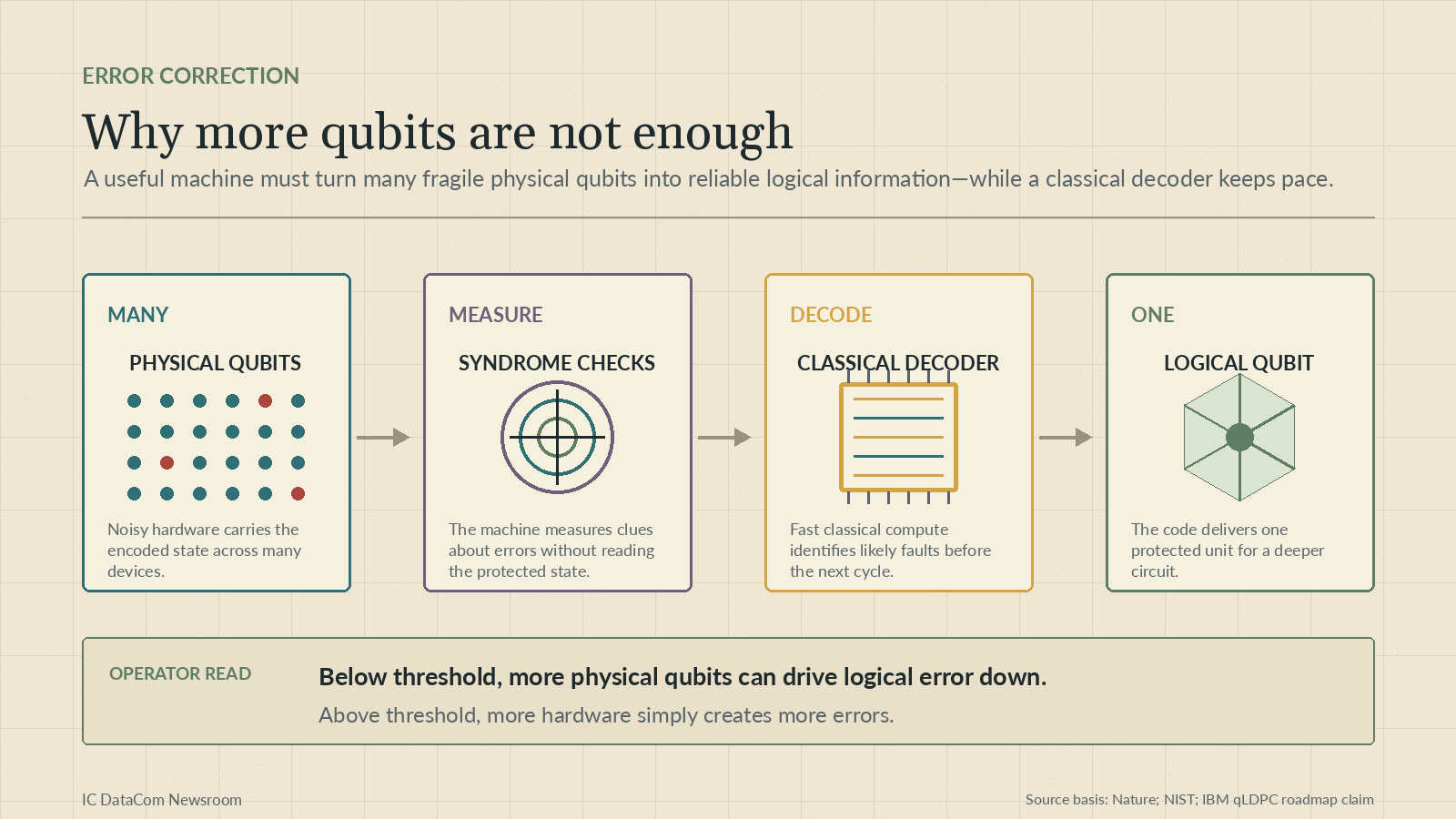
The error-correction tax: reliable logical information requires many physical qubits, repeated syndrome checks and fast classical decoding. Graphic: IC DataCom Newsroom. Source basis: Nature, NIST and IBM’s attributed qLDPC roadmap claim.
The hardware zoo
What follows is a map of engineering bets, not a ranking of finished products. Qubit counts are not equivalent across architectures, and roadmap dates remain company claims until the machines exist.
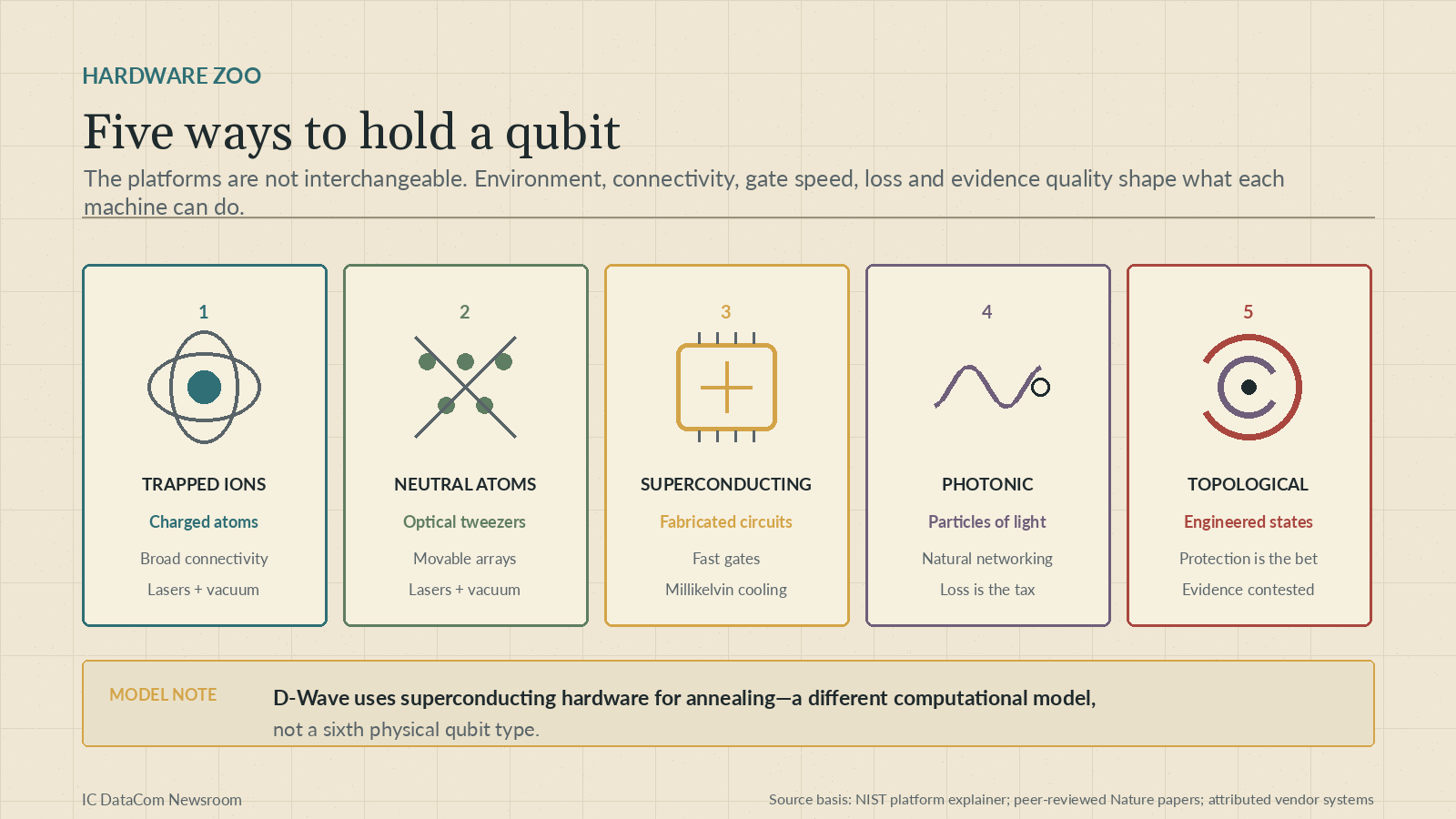
Five physical approaches, five different engineering bills. D-Wave’s annealing model uses superconducting hardware and is not a sixth physical qubit type. Graphic: IC DataCom Newsroom.
Superconducting qubits are fabricated with techniques related to semiconductor manufacturing. Their gates can be fast, and companies have built substantial control stacks around them. But the qubits require extreme cooling, tend to have relatively short coherence times and usually interact most naturally with nearby neighbors. Scaling means solving packaging, wiring, fabrication uniformity and cryogenic engineering at the same time.[17][21]
IBM's refrigerator announcement is revealing because the processor is not the whole computer. Its new modular cryogenic design offers more wiring space and is intended to connect processors across modules. IBM says it plans to place Nighthawk chips in the system and is targeting at least 1,000 programmable qubits in a linked machine by 2027. Its 2029 Starling target is a different kind of number: 200 logical qubits running circuits of 100 million gates.[1][2][32] Those are roadmap specifications, not delivered systems.
Google's Willow chip contains 105 qubits. The company used it for random-circuit sampling, a benchmark it estimated would take a leading classical supercomputer 10 septillion years to reproduce. The number is designed to stop the eye, and it does. Google also states the limitation plainly: random-circuit sampling has no known commercial application.[3] The next target is not another cosmic comparison. It is a useful computation beyond classical reach.
Trapped-ion systems trade some speed for long-lived, high-quality qubits and broad connectivity. Quantinuum says its Helios machine uses 98 fully connected barium-ion qubits, with reported two-qubit gate fidelity of 99.921 percent across all pairs. The company also reports multiple forms of logical encoding and offers Helios through cloud and on-premises arrangements.[5] IonQ publishes an aggressive modular roadmap: 12 logical qubits in 2026; 10,000 physical and 800 logical in 2027; 20,000 and 1,600 in 2028; and 200,000 and 8,000 in 2029.[9] For 2030, the company says more than 2 million physical qubits would translate into 40,000 to 80,000 logical qubits.[37] These are IonQ's targets, not delivered inventory. The further they extend into the future, the more they should be read as an engineering thesis.
Neutral atoms offer a different scaling story. Atoms are naturally identical, can be arranged with optical tweezers and may be moved into geometries suited to a computation or code. QuEra operates its 256-atom Aquila analog system through Amazon Braket. For 2028, the company describes Libra as a megaquop-class machine: more than 256 error-corrected logical qubits designed to perform roughly one million reliable logical operations at a projected one-in-a-million logical error rate.[7] Those are company targets. The peer-reviewed work behind the platform used as many as 280 physical qubits and up to 48 logical qubits; Libra remains to be built.[20]
Photonic systems promise fast operations and natural optical links between modules. Their challenge is producing, routing, interfering and detecting photons at enormous scale while coping with loss. Xanadu describes Aurora as a room-temperature 12-qubit machine built from 35 photonic chips and 13 kilometers of fiber.[38] Its Nature paper presents the system as a scale model and reports a small repetition-code demonstration with real-time decoding, not a fault-tolerant commercial computer.[16] A PsiQuantum team separately reported silicon-photonics modules fabricated through a commercial 300-millimeter process for generating, manipulating, networking and detecting heralded photonic qubits.[26] Its reported benchmark fidelities were conditional on photon detection and did not account for loss.
Then there is D-Wave. Its Advantage2 system, made generally available in 2025, has more than 4,400 superconducting qubits.[8][14] But it is an annealer, not a universal gate-model computer. Annealing machines evolve a system toward low-energy configurations and can be applied to optimization, sampling and materials problems. Their qubit counts should not be placed in a table beside IBM's, Google's or Quantinuum's as if the machines were executing the same model of computation. D-Wave says Advantage2 has solved selected problems beyond classical reach and markets production use cases.[14] The fair test for any such claim is the best specialized classical method for the same problem, cost and error tolerance.
Microsoft's bet is more radical. The company says Majorana 2 replaced Majorana 1's aluminum superconductor with lead, producing operations on microsecond timescales, mean qubit lifetimes of 20 seconds and occasional lifetimes beyond one minute—more than a thousandfold improvement over its previous processor. Microsoft says AI-assisted materials and engineering progress cut its own timeline in half to a 2029 target for a scalable machine.[13]
Topological-qubit proposals aim to encode information nonlocally so that some local disturbances have less effect; if that protection is realized in working qubits, it could reduce error-correction overhead. But this program carries unusual evidentiary history. A Microsoft-affiliated 2018 Nature paper claiming Majorana evidence was retracted in 2021 after the authors cited insufficient scientific rigor, and Nature reported in June 2026 that some researchers remained skeptical of Majorana 2's claims.[30][31] NIST likewise describes topological qubits as challenging to build and says researchers have continued seeking definitive evidence.[21] The Majorana 2 specifications remain Microsoft's account of its own hardware; independent replication and detailed peer review will determine how much weight they carry.
There may be no single winner. The future could look like classical computing, with several architectures optimized for different workloads, or like aviation, where many designs were possible but economics narrowed the field. The physics will decide part of it. Manufacturing, serviceability, software and capital will decide the rest. Roadmaps from IBM, Quantinuum and QuEra cluster around 2028 and 2029 for systems they describe as fault tolerant or commercially meaningful.[1][6][7]
Microsoft also targets 2029, while IonQ projects a steep escalation through 2030.[9][13] This agreement should not be confused with independent confirmation. Companies recruit talent, raise capital and organize partnerships around dates. Physics does not read investor presentations.
The scoreboard problem
Quantum computing has repeatedly demonstrated benchmark advantage: a quantum device performs a specified task that is prohibitively expensive to reproduce with a particular classical method and error tolerance. That can be scientifically meaningful, but it establishes an advantage only for that benchmark. Better classical algorithms can later narrow or overturn the gap.[3][18]
It is not the same as useful advantage.
The field's benchmarks tend to be chosen because quantum hardware can run them and classical computers struggle to simulate them. Customers choose problems in the opposite direction. They want an answer that improves a drug candidate, a catalyst, a battery, a logistics plan or a financial decision. They care about accuracy, time, cost and whether a classical method already works.
Classical algorithms do not stand still while quantum hardware improves. Researchers optimize tensor networks, Monte Carlo methods, linear algebra, heuristics and GPU code. They "dequantize" algorithms by finding classical methods that reproduce an apparent quantum speedup. Computer scientist Ewin Tang became known for doing exactly that to recommendation algorithms once considered promising quantum examples. Quanta summarized the broader problem bluntly: despite the hype, finding important quantum algorithms that outperform classical ones has been surprisingly difficult.[18]
Chemistry, often described as quantum computing's natural killer application, offers the cleanest warning against easy forecasts. "My main interest is in solving chemical problems. If classical computers are the right tool to do it, we should," Caltech chemist Garnet Chan told Quanta. In a paper submitted January 8, Chan's team reported using classical methods to determine the ground-state energy of a widely used model of FeMo-co, the strongly correlated metal cluster at nitrogenase's active site and a long-standing test case in quantum-computing resource estimates.[34] Quanta explained the result in May.[19] The work does not prove quantum chemistry is a dead end. It proves that "classically hard" is a moving target.
A leading candidate for early use is simulation of quantum systems, especially selected strongly correlated materials and molecular problems for which accurate classical approximations become prohibitively expensive.[19][21] Even there, a useful quantum result must include the full workflow. State preparation, error correction, repeated measurements and classical post-processing can erase a theoretical speedup.
Optimization is more treacherous. Almost every industry has optimization problems. That does not mean every optimization problem has a useful quantum algorithm, or that a quantum approach will beat decades of specialized classical software on cost and solution quality.[18][21] Machine learning is similarly easy to pitch and hard to prove. Loading ordinary classical data into a quantum state can become the bottleneck before the proposed speedup begins.
A practical test is almost insulting in its simplicity: Does the answer change a decision, and is the value of that change greater than the cost of the quantum computation?
DARPA has formalized essentially that question. Its Quantum Benchmarking Initiative is evaluating whether an industrially useful quantum computer can be built by 2033. DARPA defines utility-scale operation as computational value exceeding cost and plans staged technical verification rather than relying on vendor roadmaps.[12] The government is not asking which machine has the most photogenic refrigerator. It is asking whether the economics close.
While DARPA waits to see whether quantum computation can produce economic value, security planners are already spending money on a different possibility: that the machines may become dangerous before they become commercially useful.
The first quantum impact is already in your security plan
A machine capable of running Shor's algorithm at the scale needed to break modern public-key cryptography does not exist; NIST and the U.K. National Cyber Security Centre describe major engineering barriers and no confident arrival date.[21][23] But 2026 estimates have moved the boundary in the uncomfortable direction. Quanta reported that Caltech physicist Dolev Bluvstein, CEO of the new company Oratomic, and his collaborators designed a neutral-atom architecture that they estimate could break elliptic-curve cryptography with 10,000 atoms in about three years or 26,000 atoms in days. A Google team described a procedure with at least a tenfold reduction in the space-time cost of attacking elliptic-curve cryptography. By contrast, the Oratomic design estimates that common RSA would take about a century with 10,000 atoms or three months with 100,000.[27]
These are paper estimates, not independently demonstrated machines. Quanta reported that crucial error-correction details remained vague, outside researchers called some speed assumptions aggressive, and one asked to see the correction cycle sustained first at 100 or 1,000 qubits.[27] Google disclosed its improvement through a zero-knowledge proof that deliberately withholds the method.[27] Neither group has the hardware to perform the attacks today.
Cloudflare cited the Google and Oratomic papers in accelerating its own post-quantum target to 2029, matching a deadline Google had announced separately on March 25.[15][28] Those independent decisions are not a consensus forecast for the arrival of a code-breaking machine. Their convergence shows why “no confident date” is not the same as “no current deadline.”
An adversary can collect encrypted traffic now and wait. If the recorded traffic was protected through quantum-vulnerable public-key mechanisms and a cryptographically relevant quantum computer arrives while the information still matters, some of today's ciphertext could become decryptable. The NCSC identifies this as a present threat for data requiring long-term protection, while NIST says organizations should begin migrating before such a machine exists.[11][23]
In August 2024, NIST finalized FIPS 203, specifying ML-KEM for key establishment; FIPS 204, specifying ML-DSA for digital signatures; and FIPS 205, specifying the backup hash-based signature system SLH-DSA. NIST urged administrators to begin the transition as soon as possible because full integration takes time.[10][11]
Washington has since moved from standards to execution dates. Executive Order 14412, signed June 22, 2026, directs federal civilian high-value assets and high-impact systems to migrate key establishment to post-quantum cryptography by December 31, 2030, and digital signatures by December 31, 2031.[24] An OMB memo issued two days later requires agency migration plans within 120 days, sets a 2030 objective for mitigating as much quantum risk as feasible and phases remaining systems through 2035.[25] These are migration deadlines, not a prediction that a code-breaking machine arrives on schedule.
The order also reaches toward the federal supply chain. It directs the FAR Council to publish, within 180 days, a proposed rule that would require covered contractors to comply by December 31, 2030 with applicable NIST FIPS incorporating post-quantum algorithms.[24] A proposed rule is not yet a final contract clause, but the direction matters to vendors and service providers that expect to sell into federal environments.
That same day, companion Executive Order 14413 established a national Quantum Computer for Application Development and Discovery Science effort, directed agencies to mobilize relevant infrastructure and expertise, and called for private-sector partnership models and quantum user-facility grants—all subject to available appropriations.[36] On one afternoon, Washington ordered both an accelerated defense against quantum-enabled cryptanalysis and a government-wide push to develop and evaluate useful quantum systems.
For the broader market, NIST IR 8547 provides another planning anchor. Its initial public draft marks 112-bit-security classical public-key parameter sets as deprecated after 2030; higher-strength parameters are not deprecated on that date, but the draft disallows the listed quantum-vulnerable public-key schemes after 2035.[29] The dates are aimed at standards transition, but they turn post-quantum readiness into a lifecycle and procurement problem well beyond agencies alone.
This may be quantum computing's most important near-term story. Before the machines transform chemistry or optimization, they are forcing governments and companies to inventory cryptography, replace algorithms, update protocols and plan for systems that cannot be upgraded quickly.
Quantum readiness in 2026 is not buying quantum cloud credits. It is inventorying where RSA, finite-field Diffie-Hellman and elliptic-curve cryptography are embedded; determining how long data and signatures must remain secure; testing FIPS 203, 204 and 205 implementations; and requiring crypto-agile migration plans from vendors.
Cloudflare says more than 65 percent of human traffic to its network is already post-quantum encrypted, yet considers the migration incomplete until authentication is upgraded too.[28] Protecting stored traffic and preventing forged identities are separate workstreams.
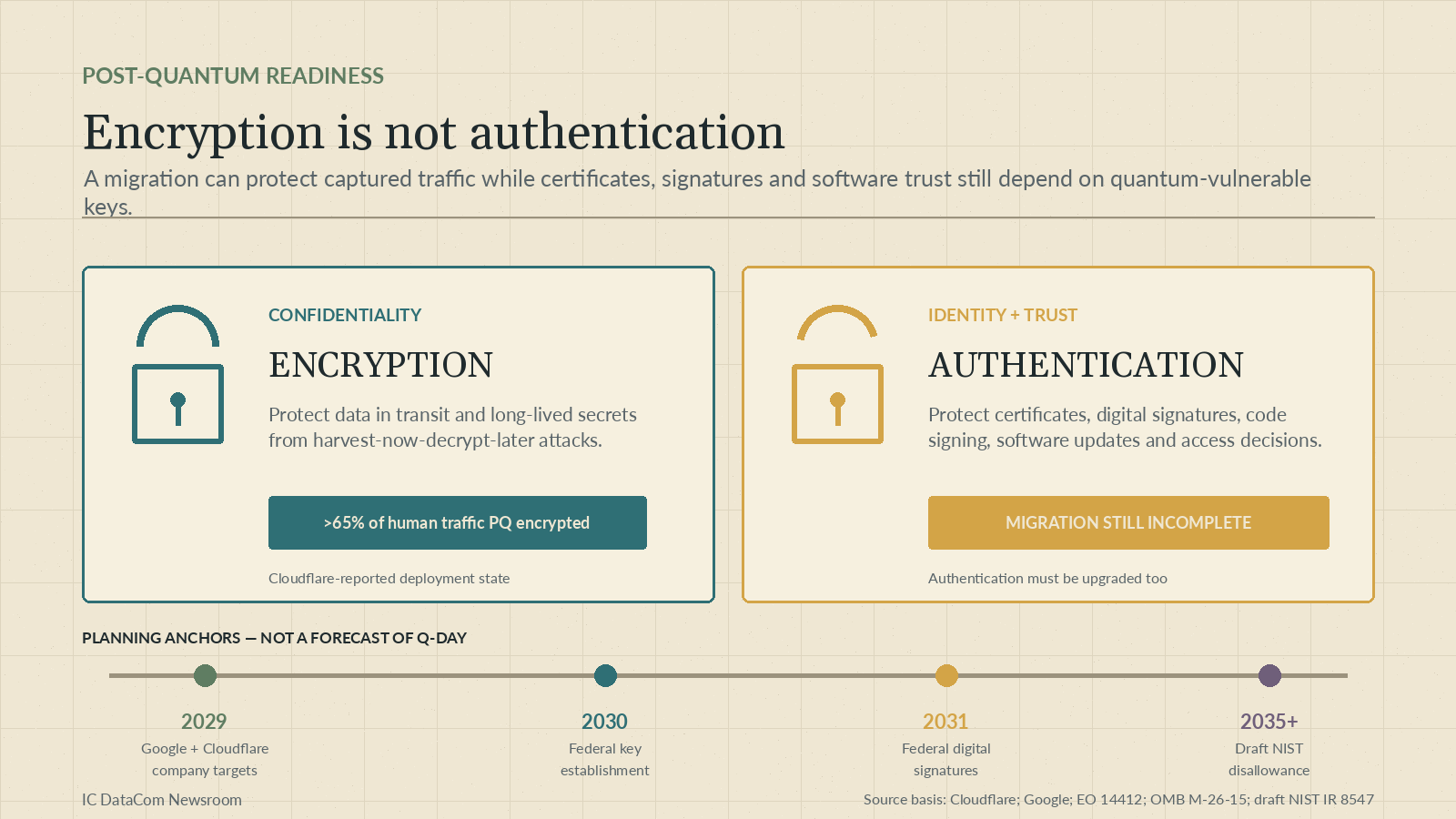
Encryption and authentication are separate migration tracks. The dates shown are company and government planning anchors, not a forecast of Q-Day. Graphic: IC DataCom Newsroom. Source basis: Google, Cloudflare, EO 14412, OMB M-26-15 and draft NIST IR 8547.
The paradox is useful: society must prepare for the destructive capability before anyone can prove the constructive business case.
When AI becomes boring old IT
That asymmetry—preparing now for a machine whose useful applications remain uncertain—also explains why quantum is unlikely to repeat AI's path into ordinary business software.
AI became a horizontal computing layer because the raw material was already digital, the hardware could be hidden behind cloud services and the same models could be adapted across writing, coding, search, analysis and media. A breakthrough became a platform. The platform became features. Features became expectations. Eventually the technology began disappearing into normal operations.
Quantum faces three constraints that point in the opposite direction. First, useful quantum algorithms are narrow: a machine that accelerates one simulation does not become better at payroll, web serving or ordinary analytics. Second, loading classical data into a quantum state can consume the advantage before the algorithm begins. Third, the hardware is not an interchangeable fleet of accelerators. It is a set of specialized physical systems whose refrigeration, vacuum, lasers, control electronics and error budgets shape what can run.
Most organizations therefore will never own a quantum computer. They may rent access through a cloud provider or send a job to a national laboratory, much as researchers use supercomputers and beamlines today. Software will need to know not merely how to call the machine, but why this stage of this problem belongs there.
The likely architecture is hybrid. Classical machines will define or compress the problem, operate the experiment, decode errors and evaluate outputs. GPUs may sit next to quantum processors because fast classical computation is part of the quantum machine. AI systems will help calibrate hardware, discover control pulses, search materials, optimize circuits and decode error syndromes. Quantum processors, in return, may eventually generate data from physical systems that classical simulation cannot reach.
An August 11 announcement makes that model concrete. Oracle and Quantinuum say Helios will be deployed inside a U.S.-based OCI AI data center and offered as a managed cloud service alongside the region's GPU and high-performance-computing infrastructure.[35] It is an announced multi-year deployment, not a completed installation, but the operating model is already clear: customers rent access to the instrument without buying the refrigerator, facilities or control stack.
That makes quantum less like the next AI and more like the next scientific-computing layer. If AI becomes electricity, quantum may become the synchrotron: rare, expensive, remotely scheduled and indispensable to a small number of problems with enormous consequences. A pharmaceutical company might never "use quantum" in the ordinary sense. Its chemistry platform may submit one stage of a simulation to a quantum back end because that stage changes which molecule advances. A utility may call a hybrid optimizer only for a specific planning problem. A materials lab may use a quantum processor to model a state no classical approximation can hold together.
The winners may not be the companies that manufacture the most qubits. Control electronics, cryogenics, error-correction software and cloud orchestration may become durable businesses regardless of which qubit wins. So may the companies that know when not to use quantum.
Quantum could become a specialized accelerator inside high-performance computing, useful for a small number of simulations near the end of this decade or early in the next. It could work technically yet remain confined to national laboratories, defense programs and scientific facilities because the economics never broaden. Or an unexpected architecture and application could arrive together, giving the field a market its current roadmaps barely anticipate.
The machine has to earn its keep
Quantum computing does not need another declaration that it will change everything. It needs a result that survives contact with a classical competitor, an accounting department and a scientist who only cares whether the answer is right.
The progress is real: Google pushed a surface-code memory below threshold; neutral-atom teams operated dozens of encoded qubits; and Quantinuum reports increasingly sophisticated logical control on trapped-ion systems.[4][5][20] IBM is building modular cryogenic infrastructure under its fault-tolerant roadmap, while NIST has moved post-quantum cryptography from research into standards.
Quantum computing already has spectacle. What it lacks is a useful answer at a defensible cost.
By the time AI becomes boring old IT, quantum may still be visible because it never became ordinary. It may live behind a cloud endpoint attached to a machine colder than space, invoked for a few minutes by software that knows exactly why it is there. Most people will never see it. Most workloads will never need it.
That would not make quantum computing a disappointment. It would mean the technology finally stopped auditioning for the role of magic and found a job.
Reporting note
Company system specifications and roadmap dates in this article are attributed targets or vendor-reported results unless tied directly to a peer-reviewed paper. Cross-platform qubit counts are not presented as equivalent performance measurements. Nature published an Author Correction to the Willow paper on April 28, 2026, amending Figure 3a labels and keys; the correction is recorded here rather than interrupting the body narrative.[33] Current-state reporting was reviewed on August 22, 2026. The cover is an AI-assisted conceptual editorial illustration; the three diagrams are original programmatic newsroom graphics. None is documentary evidence of a deployed quantum system.
Sources
- IBM Connects Its First Modular Cryogenic Systems in Milestone Toward Fault-Tolerant Quantum Computing IBM Logo Submit Facebook Twitter LinkedIn — IBM Newsroom
- Quantum Roadmap — IBM
- Meet Willow, our state-of-the-art quantum chip — Google
- Quantum error correction below the surface code threshold — Nature
- Introducing Helios: The Most Accurate Quantum Computer in the World — Quantinuum
- Quantinuum Overcomes Last Major Hurdle to Deliver Scalable Universal Fault-Tolerant Quantum Computers by 2029 — Quantinuum
- Quera Announces 2028 Fault Tolerant Quantum Computer And Expanded Multi Year Strategic Collaboration With Aws — QuEra
- Annealing Implementation and Controls — D-Wave Quantum Computing Products documentation — D-Wave
- Roadmap — IonQ
- NIST Releases First 3 Finalized Post-Quantum Encryption Standards — NIST
- Post-Quantum Cryptography — NIST
- Quantum Benchmarking Initiative — DARPA
- Majorana 2: Microsoft's Scalable Quantum Processor With Reliable, Long-Lasting Qubits — Microsoft Quantum
- D-Wave Announces General Availability of Advantage2 Quantum Computer, Its Most Advanced and Performant System — D-Wave
- Google’s timeline for PQC migration — Google
- Scaling and networking a modular photonic quantum computer — Nature
- Building a Quantum Computer, One Fragile Qubit at a Time — Quanta Magazine
- What Is the True Promise of Quantum Computing? — Quanta Magazine
- Key Chemistry Question Answered, No Quantum Computer Required — Quanta Magazine
- Logical quantum processor based on reconfigurable atom arrays — Nature
- Quantum Computing Explained — NIST
- [quant-ph/9605043] A fast quantum mechanical algorithm for database search — arXiv
- Preparing for Quantum-Safe Cryptography — UK NCSC
- Securing the Nation Against Advanced Cryptographic Attacks — The White House
- M-26-15: Execution of the Migration to Post-Quantum Cryptography — The White House
- A manufacturable platform for photonic quantum computing — Nature
- New Advances Bring the Era of Quantum Computers Closer Than Ever — Quanta Magazine
- Cloudflare targets 2029 for full post-quantum security — Cloudflare
- IR 8547, Transition to Post-Quantum Cryptography Standards — NIST
- Microsoft upgrades controversial quantum chip — researchers are still sceptical — Nature
- Evidence of elusive Majorana particle dies — but computing hope lives on — Nature
- IBM Sets the Course to Build World's First Large-Scale, Fault-Tolerant Quantum Computer at New IBM Quantum Data Center - Jun 10, 2025 IBM Logo Submit Facebook Twitter LinkedIn — IBM Newsroom
- Author Correction: Quantum error correction below the surface code threshold — Nature
- [2601.04621] Classical computational simulation of the FeMo-cofactor model to chemical accuracy and its implications — arXiv
- Quantinuum and Oracle Partner to Accelerate Hybrid Quantum Compute Adoption on Oracle Cloud Infrastructure — Oracle
- Ushering in the Next Frontier of Quantum Innovation — The White House
- IonQ's Accelerated Roadmap: Turning Quantum Ambition into Reality — IonQ
- Xanadu introduces Aurora: world's first scalable, networked and modular quantum computer — Xanadu / PR Newswire