Terence Willis Has a Plan for an African Town on Detroit's Dexter Avenue
A KBLA interview led GSJ to a Dexter Avenue property, a $7.5 million proposal and a 2004 City Council record — plus questions about ownership, financing and public money.
Preview the new Groove Detroit podcast series
Synthetic narration · warm African American woman storyteller style · temporary Groove Detroit series preview · not a real host or interview participant · 1:55
Temporary 1:55 series preview with synthetic narration, not a recording of a real host or interview participant. The full narrated investigation is not currently published while reporting and production continue.
DEVELOPING — Published August 2, 2026.
A radio interview from Los Angeles landed in Detroit with an audacious proposition: take a section of Dexter Avenue, build around African and African American culture, connect it to commerce across the diaspora and turn a neighborhood identity into lasting local ownership.
The man making the case was Terence Willis, introduced on KBLA Talk 1580 as president of the African Town Community Development Corporation. His pitch moved easily between Detroit real estate, Black cultural history, international trade and political power.
"African Town is really a strategy," Willis told host Dominique DiPrima during the April 15 broadcast. "It's meant to be an open-source strategy that's leveraged by African communities around the world."
The interview is persuasive. It is also the beginning of a story, not the end of one.
There is a real building at 12305 Dexter Avenue. Public property data associates it with Moore Place LLC, an active Michigan company for which Willis is publicly listed as registered agent. AfricanTown's website says the company acquired the building for $500,000 and that the proposed Sankofa Arts & Culture Center carries a $7.5 million capital budget.
There is also a real city streetscape project on Dexter and a newly renovated Helen Moore Community Center. But the public investments named during the interview are parallel neighborhood projects. The conversation does not establish that AfricanTown CDC controls those public dollars.
And there is a real City Council record from 2004. It is more complicated than a simple claim that Detroit "sanctioned" African Town.
This is what GSJ can establish at the start of its reporting, what remains a claim, and what we intend to find out.
The pitch: culture as an economic engine
Willis begins with a familiar Detroit comparison. The city has Greektown and Mexicantown. Other cities have Chinatowns and Little Italys. Those districts use culture to create a destination, concentrate commerce and keep a community visible.
His proposed "cultural economic zone" would do the same for the African diaspora on Detroit's West Side. Willis defines "African" broadly to include people of African descent around the world. In his telling, restaurants, art, fashion and entertainment are the front door. Trade is the larger ambition.
"African towns should serve as a portal for trade," he said, describing business links among Detroit, African countries and diaspora communities elsewhere.
That is a bigger idea than a heritage district. Willis is arguing for a neighborhood platform: a place that attracts customers, helps Black-owned firms share infrastructure, brings capital into real estate and eventually concentrates enough economic strength to influence politics.
He identifies six neighborhoods around the corridor and describes a roughly 2.5-square-mile area. The current AfricanTown website draws its own "territory bounded zone" from Davison Avenue south to West Grand Boulevard, and from Linwood Street west to Grand River Avenue. The site calls 12305 Dexter the physical and spiritual anchor.
The plan is ambitious enough to invite two opposite mistakes. One would be to dismiss it as branding. The other would be to confuse the whole vision with completed development.
The building behind the vision
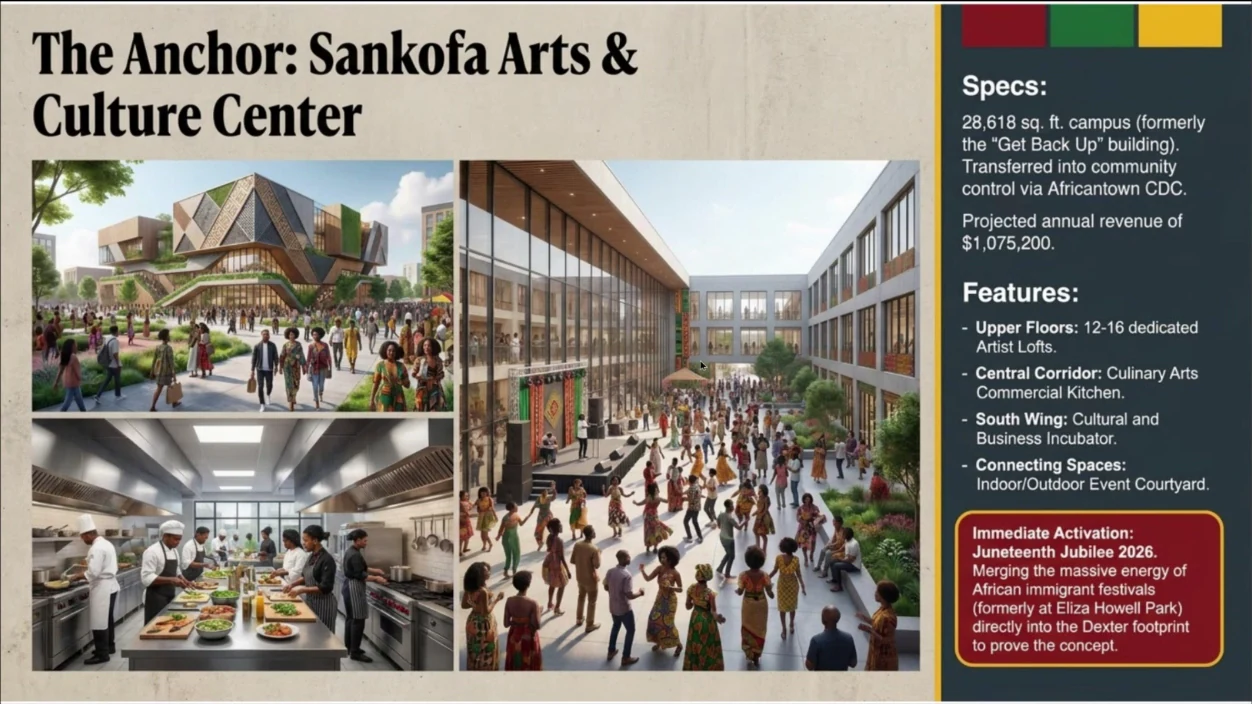
AfricanTown's flagship proposal is the Sankofa Arts & Culture Center, a planned adaptive reuse of a former school at 12305 Dexter.
The organization's website describes a 28,000-square-foot project with event space, ten live-work lofts, a shared commercial kitchen, coworking and technical labs, retail storefronts, and archival space. It projects $1,075,200 in annual gross revenue across those uses. Those are sponsor projections, not audited operating results; the center is not yet operating at that scale.
The site lists a total capital budget of $7.5 million: $500,000 for an acquisition it marks complete and $7 million for rehabilitation. It solicits tax-deductible contributions toward the build-out.
Detroit's official Base Unit parcel viewer gives the proposal a concrete footprint. It identifies 12305 Dexter as parcel 14006214-21, a taxable, privately held commercial property, and names Moore Place LLC as the taxpayer. The city viewer records a $500,000 sale price but pairs it with a July 30, 2007 sale date. That may not describe the acquisition AfricanTown now marks complete, so it should not be treated as a clean transaction history without the deed.
Public Michigan business indexes list Terence Willis as Moore Place LLC's registered agent. They also associate him with 12th Street Community Development Corporation, a Detroit nonprofit formed in 2017. ProPublica's IRS-derived Nonprofit Explorer lists 12th Street CDC under EIN 82-1227265, names Terence D. Willis in its care-of field and shows an October 2019 ruling date. But GSJ's August 2 search of the IRS's current Michigan tax-exempt-organization file did not return that EIN. That does not establish why the record is absent; it means the organization's current federal tax-exempt status requires direct confirmation before readers should rely on the website's tax-deductibility language.
What the public-facing AfricanTown pages do not clearly explain is how those entities fit together.
Is AfricanTown CDC a new legal corporation, a public name for 12th Street CDC, a program under it, or a separate partnership? What agreement connects the nonprofit to Moore Place LLC? Who sits on the board? If charitable money improves privately held property, what covenants preserve the public benefit? Those questions do not imply misconduct. They are ordinary governance questions for a project asking the public, donors and investors to participate.
The website adds another layer. It says AfricanTown is working toward an EB-5 regional center, a federal structure that can pool qualifying foreign investment tied to U.S. job creation. The same page labels that certification and the area's targeted-employment-area status as pending. There is no basis yet to describe AfricanTown as an approved EB-5 regional center.
The millions named on air
At about 22 minutes into the KBLA interview, DiPrima lists $9.5 million for a Dexter streetscape, $12 million for the Helen Moore Community Center and park, $1.5 million through the Strategic Neighborhood Fund, and $1 million in targeted grants. She initially describes the money as investments AfricanTown is overseeing.
Willis qualifies the premise.
"It's also a part of other initiatives that are focused in this same area simultaneously," he says.
That sentence is the hinge between a neighborhood investment story and an AfricanTown financing story.
Detroit's Department of Public Works completed a Dexter streetscape project between Davison and Webb in fall 2024. City materials describe safer crossings, a separated bike lane and other corridor improvements. A November 2025 city statement valued the completed streetscape at $10 million. The work exists. It is municipal infrastructure, not evidence of a $9.5 million grant to AfricanTown CDC.
The Helen Moore Community Center renovation also exists. The same city statement put the complete project, including Ed Davis Park, at $11.9 million in American Rescue Plan Act funding. It opened in November 2025 with a gym, computer lab, kitchen classroom, art and STEM rooms, and other facilities. AfricanTown's site lists that center, the streetscape and other nearby work as "partner projects, adjacent developments, and municipal infrastructures" in the surrounding ecosystem.
That is a legitimate argument: public improvements can make a privately or philanthropically financed cultural hub more viable. But adjacent investment is not the same as money under the CDC's control.
GSJ has not yet located public award documents tying the quoted $1.5 million Strategic Neighborhood Fund figure or $1 million in targeted grants directly to AfricanTown CDC. Until that documentation is produced, those figures should not be added to Sankofa's capital stack.
The 2004 record is real, and it changed within months
African Town did not begin with Willis's 2026 radio appearance.
Detroit's official 2004 City Council proceedings show that the council hired Dr. Claud Anderson's PowerNomics organization for up to $112,440 to develop an economic plan. Anderson's June report proposed an inner-city business district for African American businesses, called African Town, and a capital fund.
On July 14, the council approved two resolutions. One designated Black Detroiters as the city's "majority" and "under-served" population. The other supported creating a Detroit Capital Development Corporation with a proposed $30 million loan pool drawn from anticipated casino funds.
The votes triggered a fierce argument over race, legality, immigrant communities and who could receive public support. Council members who opposed the plan called its proposed classifications exclusionary. Supporters argued that a majority-Black city still lacked a successful African American business district comparable to the ethnic commercial districts Detroit promoted elsewhere.
The council record also contains a warning that matters now. Kenneth Cockrel Jr., who supported the July resolutions, wrote that they did not have the force of law. They were statements of intent requiring much more work with the mayor, city agencies and development organizations.
On October 18, the council adopted a clarifying resolution. It acknowledged that existing law would not permit the capital fund and business district to proceed as originally described. The new resolution supported a lawful African American heritage business district open for all ethnic groups to enjoy, asked the Detroit Economic Growth Corporation and City Planning Commission to develop a plan, and said it superseded prior resolutions on the matter.
So what did Detroit officially do in 2004? It endorsed the goal of an African American cultural and business district and asked city development bodies to work on it. It did not enact a geographically defined African Town by ordinance, deliver the proposed $30 million fund, or create the current Dexter organization.
Any claim of direct institutional continuity from the 2004 council action to today's AfricanTown CDC still needs a documentary bridge.
The story Willis tells about Dexter
Willis places the project in a corridor dense with Black institutional history. In the interview he points to the Nation of Islam, the Shrine of the Black Madonna, the Republic of New Afrika, New Bethel Baptist Church and Motown's nearby presence.
He also makes a more provocative argument about the corridor's decline. Willis says Dexter's former commerce made Tulsa's Black Wall Street "pale in comparison" and attributes the fall primarily to "Black disinvestment" and an erosion of culture, rather than white disinvestment.
Those are his interpretations. They are not established in the interview.
A history of Dexter's commercial decline would have to account for redlining, discriminatory credit and appraisal practices, population loss, highway and urban-renewal decisions, deindustrialization, suburbanization, municipal policy and changes in where Black households spent and invested money. Willis's emphasis on internal purchasing and cultural cohesion may be part of that story. It cannot substitute for the rest of it.
The same discipline applies to his description of Detroit as the country's best real-estate opportunity and a national leader in property appreciation. Those are investment arguments that require dates, datasets and neighborhood-level context. Appreciation can build wealth for an owner. It can also raise rents and taxes for residents who do not own enough of the upside.
That tension is central to AfricanTown's promise. If cultural identity makes Dexter more valuable, who captures the value?
Who is Terence Willis?
The interview introduces Willis as a serial entrepreneur who owns an information-technology company, works in real estate and has conducted business in Africa since the late 1990s. Michigan business indexes connect him to Moore Place LLC and 12th Street CDC.
The spelling matters. KBLA's visible title materials and some automatic transcripts use "Terrence." Business indexes, organizational materials and the address provided for outreach use "Terence Willis." GSJ is using Terence unless Willis tells us otherwise.
What the public record does not yet supply is a complete project biography: Willis's formal title across every entity, the current CDC board, past completed developments, financing partners, the history of the African trade activity he describes, or the relationship between his commercial businesses and the nonprofit project.
Those are subjects for an interview, not blanks to fill with inference.
What GSJ is asking next
This first report establishes a serious proposal with a real property, a published program, a fundraising target and a long Detroit political backstory. It also finds a project whose public explanation is ahead of its disclosed governance and financing documents.
GSJ is seeking an on-record interview with Willis. We are asking for:
- the CDC's exact legal name, incorporation record, IRS status, board roster and conflict-of-interest policy;
- the ownership and governance agreement for Moore Place LLC and 12305 Dexter;
- the deed, development budget, sources-and-uses statement and current fundraising commitments;
- permits, design approvals, construction milestones and the target opening date for Sankofa;
- documentation separating AfricanTown-controlled funds from nearby city investments;
- the legal status of the proposed EB-5 regional center and any investor offering;
- evidence for the projected annual revenue;
- the mechanism connecting Dexter businesses to trade partners in Africa;
- affordability, anti-displacement and resident-ownership protections; and
- the historical and organizational link, if any, between the 2004 council initiative and the current CDC.
We also intend to speak with nearby residents, merchants, city officials, historians and the organizations responsible for the parallel public projects.
AfricanTown may become a model for turning Black culture into Black-owned assets. It may become one development among several riding a wave of public investment. It may become both. The answer will be found in deeds, budgets, contracts, board records, construction work and the experience of the people already living along Dexter.
The radio interview gave the project a microphone. Now the reporting begins.
GSJ will update this story when AfricanTown provides governing and financing records, when city agencies clarify the public funding cited in the interview, or when construction milestones can be independently verified.
Primary-source visuals
Inside the AfricanTown proposal
These images identify the interview subject and show the proposal materials being examined. They are evidence of how the project is presented—not proof that the depicted work is financed, approved or complete.
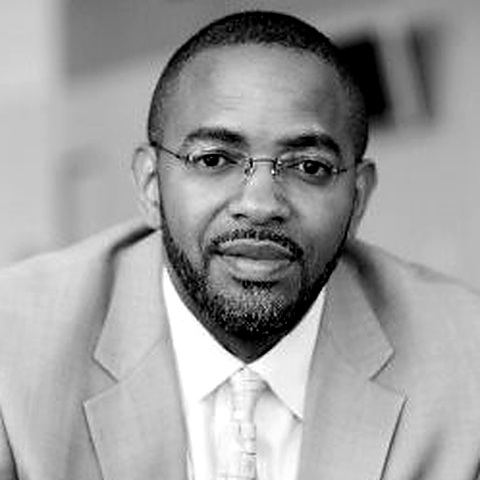
Accessible image description
A tightly framed portrait of Terence Willis against a neutral background. The image identifies the person whose KBLA interview prompted GSJ's review of the AfricanTown proposal and public records.
Source context: Established Episode 0 portrait asset; photographer is not documented in the local source record; no generative reconstruction.
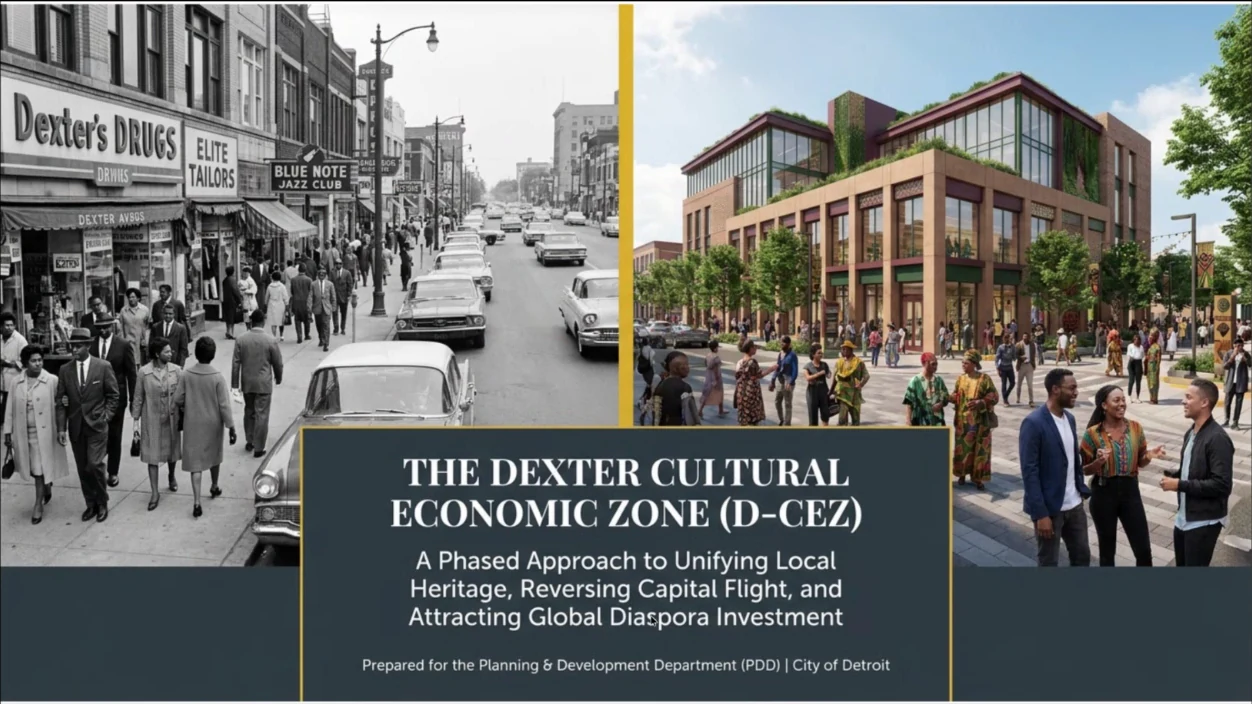
Accessible image description
The slide places a black-and-white historic Dexter commercial scene beside a modern conceptual streetscape rendering. A center panel calls the idea The Dexter Cultural Economic Zone and describes a phased approach to local heritage, capital flight and diaspora investment. Fine print says it was prepared for Detroit's Planning and Development Department; that visible statement is part of the source slide and is not treated as proof of City adoption or approval.
Source context: Frame titled The Dexter Cultural Economic Zone from the recorded presentation at approximately 47:28; reproduced for reporting.
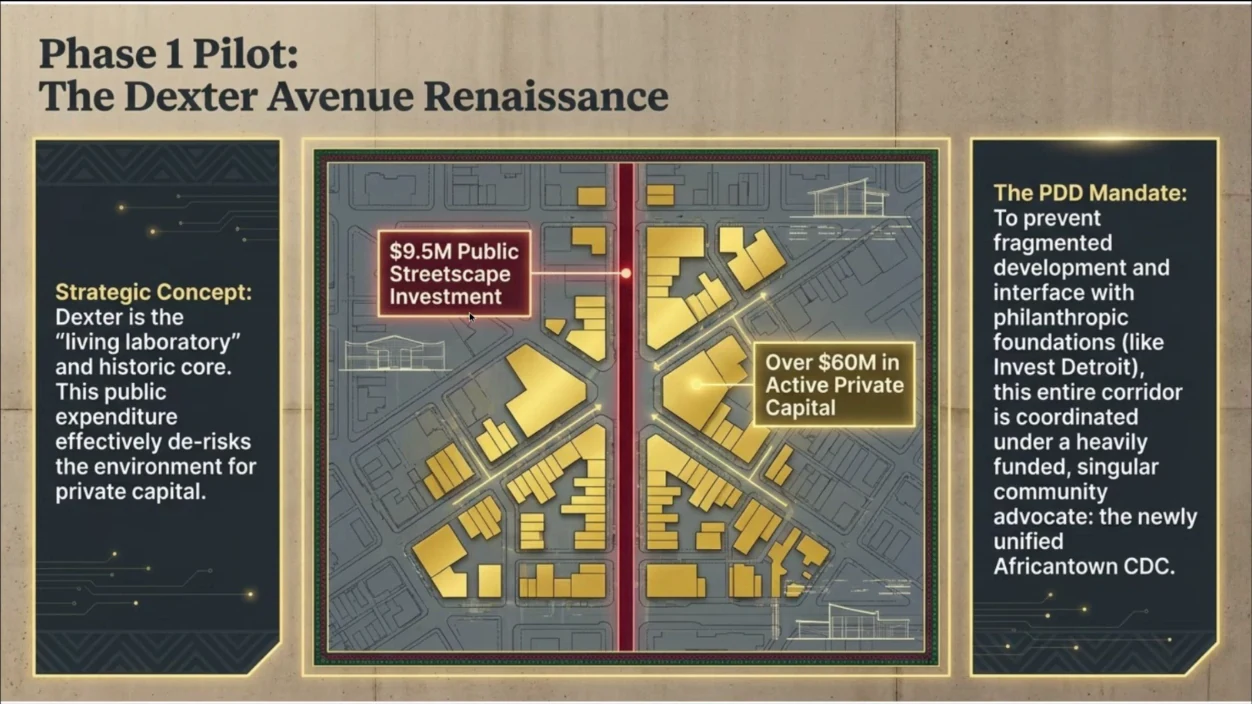
Accessible image description
The slide centers a corridor map with highlighted parcels. It displays sponsor figures of $9.5 million in public streetscape investment and more than $60 million in active private capital, alongside language describing a PDD mandate and a unified AfricanTown CDC. Those figures and relationships are presentation claims, not independently verified facts established by displaying the slide.
Source context: Frame titled Phase 1 Pilot: The Dexter Avenue Renaissance from the recorded presentation at approximately 53:48; reproduced for reporting.
Accessible image description
The slide shows exterior, courtyard and commercial-kitchen concepts. It lists a 28,618-square-foot former school, an annual revenue projection of $1,075,200 and proposed artist lofts, culinary space, coworking, technical labs and a courtyard. A red panel describes an Immediate Activation concept. These specifications, projections and activation claims require documentary confirmation.
Source context: Frame titled The Anchor: Sankofa Arts & Culture Center from the recorded presentation at approximately 54:28; reproduced for reporting.
Accessible image description
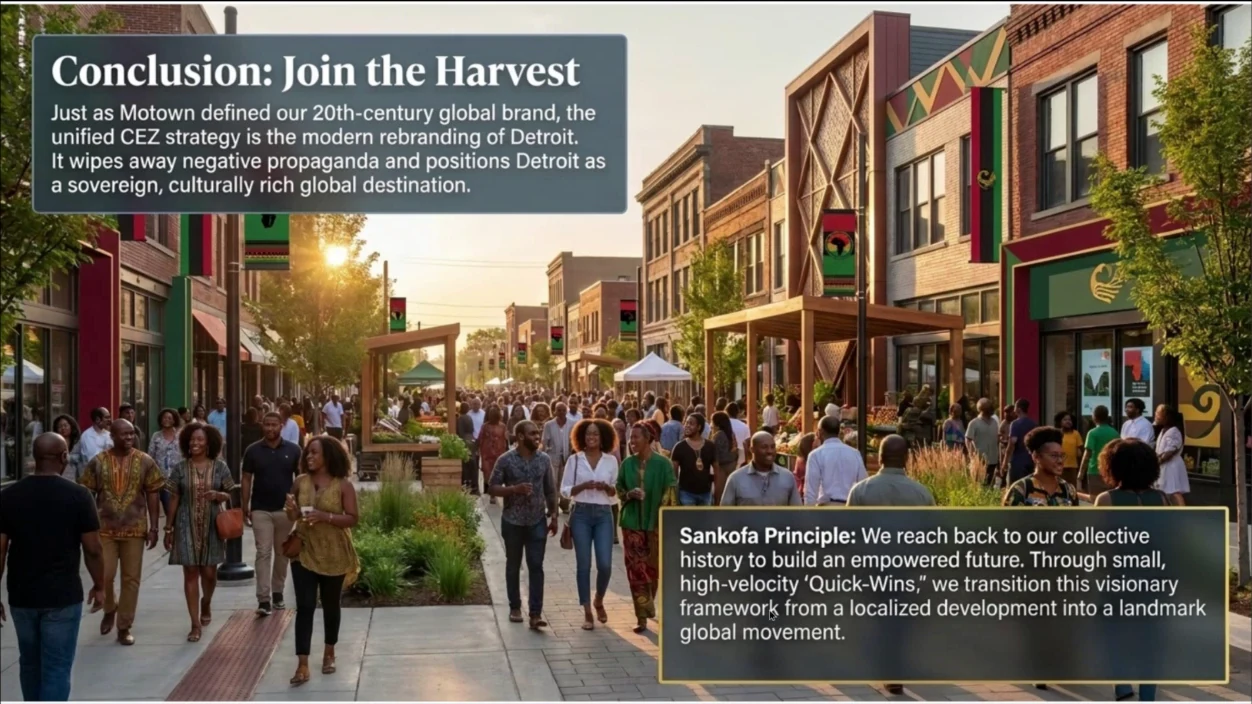
The conceptual streetscape uses African-inspired colors and storefront details. Text calls the proposal a unified cultural-economic-zone strategy and describes a Sankofa Principle of building an empowered future through collective history. The scene is an aspiration, not a photograph of completed or approved development.
Source context: Frame titled Conclusion: Join the Harvest from the recorded presentation at approximately 57:38; reproduced for reporting.
Image note: Proposal imagery does not establish construction, financing, ownership, or City approval. These AfricanTown source materials are reproduced for reporting; visible proposal claims remain claims until independently documented.
Sources
- Detroit's African Town is Revitalizing a Black District with Cash, Culture and Community + Hot Topics — KBLA 1580
- AfricanTown Detroit CDC | Historic West Side Revitalization — AfricanTown Detroit CDC
- Our Heritage & Future — AfricanTown Detroit CDC
- Capital Campaigns & Direct Options — AfricanTown Detroit CDC
- B2B Diaspora & EB-5 Portal — AfricanTown Detroit CDC
- City Council Proceedings, 2004 — City of Detroit
- Dexter Streetscape Project — City of Detroit
- City opens Helen Moore community center, Ed Davis Park — City of Detroit
- 12305 Dexter parcel 14006214-21 — City of Detroit Base Unit Tools
- 12th Street Community Development Corporation — ProPublica Nonprofit Explorer
- Moore Place LLC — Michigan Company Directory
- 12th Street Community Development Corporation — Michigan Company Directory
- Exempt Organizations Business Master File Extract (Michigan) — Internal Revenue Service